



About US Lightning Map
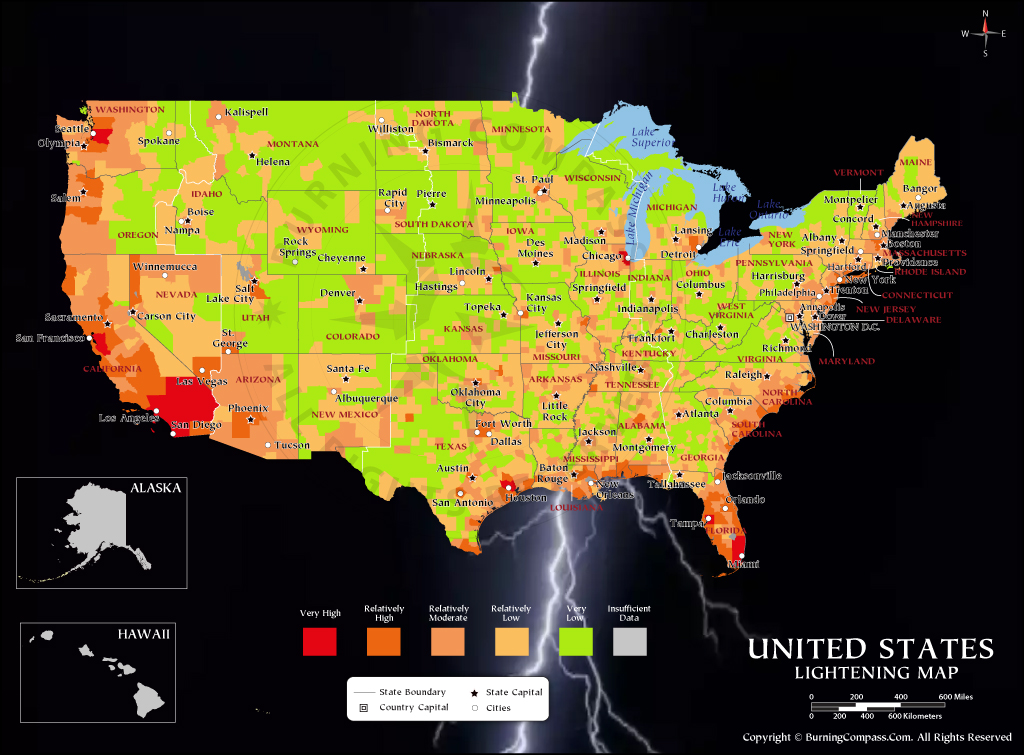
This US lightning map shows lightning density across the United States. Areas with very high lightning density are shown in red, while areas with very low lightning density are shown in green. It functions like a heat map, illustrating variations in lightning activity across the country using different color codes. The map also displays all 50 states with their boundaries and capitals, along with the national capital, Washington DC, and major cities. Alaska and Hawaii are shown in grey in inset maps, as these states have insufficient data for lightning density.
Lightning Density Across the United States
Lightning can strike anywhere, but some places are more prone to it than others. In the United States, for example, the frequency of lightning strikes varies greatly from one region to another. This is measured by something called lightning density, which is basically the number of lightning flashes that occur in a given area over a certain period of time, usually a year. It's an important tool for scientists, city planners, and emergency responders to understand the risks associated with severe weather and to prepare for potential disasters. The country's diverse landscape, climate, and seasonal weather patterns all contribute to its unique lightning profile, making it a fascinating subject for study. By looking at lightning density, gives better sense of which areas are most at risk and how to mitigate those risks.
Understanding Lightning Density and How It Is Measured
Lightning density is basically how many lightning strikes happen in a certain area over a year. We can get really accurate data on this now thanks to advanced systems like the National Lightning Detection Network and satellites like NOAA's Geostationary Lightning Mapper. These tools give us super detailed, almost real-time information on lightning strikes.
Researchers track two types of lightning: the kind that hits the ground and the kind that happens inside clouds. But they focus more on the kind that hits the ground because it's the most dangerous to people, buildings, and roads. They use this information to create maps that show where lightning is most common. These maps use different colors to show how often lightning strikes in different areas - red for places that get a lot of lightning and green or blue for places that don't get as much. This helps us see where lightning is more likely to happen.
National Lightning Activity
Lightning is a pretty common and really powerful thing that happens with the weather in the US. The country gets hit with around 25 million lightning flashes every year, which shows just how big of a deal this natural hazard is.
In the US, you get around 100,000 thunderstorms every year, and each one of them can produce lightning, so it's a risk that's always there, everywhere.
Lightning is still a big threat, even with better warnings and forecasts. Every year, it hurts and kills people, making it one of the most dangerous weather problems we face.
Regional Patterns of Lightning Density in the United States
Lightning doesn't strike everywhere in the US equally. It actually happens more often in some areas than others, and this is because of things like how hot or cold it is, how much moisture is in the air, how stable the atmosphere is, and what the land is like in different places.
Southeast
Florida is known for having a lot of lightning, more than anywhere else in the country. This is because of the warm, moist air and the way the sea breeze interacts with the land, which causes a lot of thunderstorms. Some parts of Florida have over 100 days of thunderstorms every year, which is why the lightning density is so high. The combination of these factors makes Florida the perfect place for lightning to strike, earning it the title of "lightning capital".
Florida is actually a hotspot for lightning, with some areas getting hit really hard - we're talking super high numbers of lightning flashes per square kilometer every year.
Southern Plains and Gulf Coast
Texas, Oklahoma, Louisiana, and Arkansas are some of the states that get hit with a lot of lightning. But Texas stands out - it's the state with the most lightning events, and that's because it's really big and gets a lot of storms.
These areas get hit with really strong storms, especially in the spring and summer, which means they see a lot of lightning.
Midwest and Central United States
The Midwest gets a lot of lightning, especially when thunderstorms are at their worst. This is because the air in the Midwest can be very unstable, which means it's easy for big storms to form. When different air masses meet, like when a front comes through, it can create perfect conditions for severe weather like lightning, hail, and even tornadoes.
Western United States
The western U.S., including states like California, Nevada, and Washington, generally experiences lower lightning density. This is primarily due to drier climates and fewer thunderstorms. However, mountainous regions can still experience localized lightning activity, especially during summer monsoon conditions in the Southwest.
Northern United States
In the northern parts of the country, like the Great Lakes and New England, lightning isn't as common as in other areas. It usually happens most often during the summer. The reason it's not as frequent is because it gets cooler and the thunderstorm season is shorter, especially when compared to the South.
Seasonal Variation in Lightning Density
In the United States, lightning is more common during certain times of the year. Most lightning strikes happen in the late spring and summer, when it's warm and humid. This kind of weather is perfect for thunderstorms to form.
In the winter, you don't get as much lightning, but it can still happen when there are really strong storms, like thunderstorms or even snowstorms that have thunder in them, which some people call "thundersnow".
Factors Influencing Lightning Distribution
across the United States. Warm, moist air is a primary driver, as it fuels the development of cumulonimbus clouds where lightning originates. Atmospheric instability, caused by temperature differences between air layers, also plays a key role in storm formation.
The shape of the land can also affect where lightning strikes. For instance, in Florida, the breeze coming in from the sea can make thunderstorms form more easily. Meanwhile, in areas with lots of mountains, the air can rise and create storms in specific spots.
Importance of Lightning Density Maps
Having a good idea of where lightning is likely to strike is really important for a lot of different groups, like city planners, engineers, and insurance companies. They use special maps called lightning density maps to figure out which areas are at a higher risk of being hit by lightning. This information helps them design buildings and roads that can withstand big storms. It's also super useful for people who organize outdoor events or work in aviation, because they need to know when it's safe to be outside or fly a plane. With real-time lightning data, they can make informed decisions to keep people safe.
These maps are also really helpful for meteorologists to figure out when bad weather is coming and to warn people ahead of time, which can save lives and prevent damage to property.
FAQs about Lightning in the United States
Other US Maps
- US Map
- Detailed US Map
- Blank Map of US
- USA Karte
- Mapa de Estados Unidos
- Carte des États-Unis
- Mapa dos Estados Unidos
- USA Time Zone Map
- US National Parks Map
- US Regions Map
- US Rivers Map
- USA World Map
- USA on World Map
- US Cities Map
- US State Abbreviation Map
- US Road Map
- US Travel Map
- US Rail Map
- US Territory Map
- US Zip Code Map
- US Physical Map
- US County Map
- Blank US County Map
- US Population Map
- Richest Cities in US
- US International Airports Map
- US Flag Map
- US Map Upside Down
- US Temperature Map
- US Latitude and Longitude Map
- East Coast Map
- West Coast Map
- Western US Map
- US Interstate Map
- USA Seismic Zones Map
- US Canada Map
- US Mexico Map
- Southern US Map
- US Elevation Map
- US Map Black and White
- US Midwest Map
- US Northeast Map
- Amtrak Map
- 13 Colonies Map
- Washington DC Map
- Best Places to Visit in Summer in USA
- US on North America Map
- Southeast US Map
- US Mountain Ranges Map
- Southwest US Map
- Northwestern US Map
- US Map without Names
- US Canada Border Map
- US Area Code Map
- American Civil War Map
- US Road Trip Map
- US Volcano Map
- New England Map
- US Satellite Map
- US Desert Map
- US Map 1860
- US Map 1800
- US Map 1850
- US Lakes Map
- Where is Niagara Falls
- Where is Grand Canyon
- Where Mount Rushmore
- Where is Statue of Liberty
- Where is White House
- Where is Hoover Dam
- Where is Golden Gate Bridge
- Where is Hollywood Sign
- Where is Empire State Building
- Where is Monument Valley
- Where is Lincoln Memorial
- Where is Gateway Arch
- Where is Great Smoky Mountains
- Where is Sears Tower
- Where is Independence Hall
- Where is One World Trade Center
- US Climate Map
- Where is Rocky Mountains
- Where is Old Faithful Geyser
- US Capital
- US Map in Gujarati
- US Lightning Map
- US Snow Cover Map
- US Topographic Map
- Central US Map
- US Ethnicity Map