



About US Map
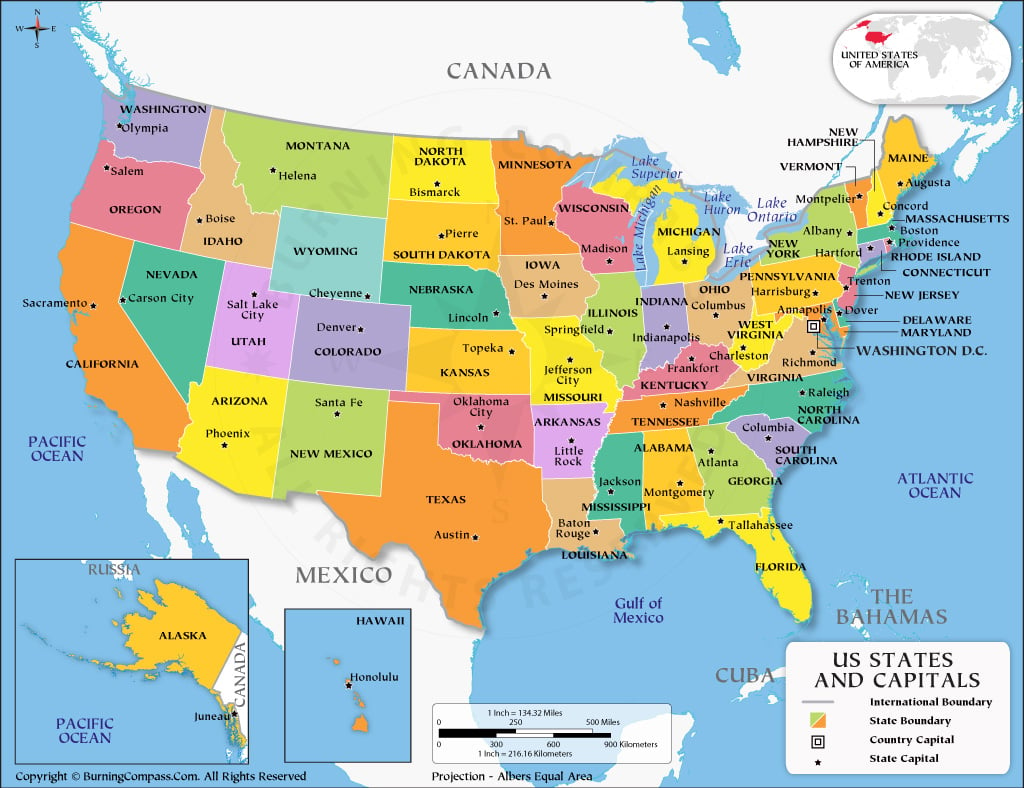
The above USA map displays all 50 states along with their capitals, the national capital Washington, D.C., state boundaries, and international borders. Alaska and Hawaii are shown in insets. The neighboring countries of the United States, Canada and Mexico, are also shown on the US map.
US States and their Capitals
The following list presents all 50 states of the United States along with their capitals.
| S.N. | State Name | State Capital Name |
|---|---|---|
| 1 | Alabama | Montgomery |
| 2 | Alaska | Juneau |
| 3 | Arizona | Phoenix |
| 4 | Arkansas | Little Rock |
| 5 | California | Sacramento |
| 6 | Colorado | Denver |
| 7 | Connecticut | Hartford |
| 8 | Delaware | Dover |
| 9 | Florida | Tallahassee |
| 10 | Georgia | Atlanta |
| 11 | Hawaii | Honolulu |
| 12 | Idaho | Boise |
| 13 | Illinois | Springfield |
| 14 | Indiana | Indianapolis |
| 15 | Iowa | Des Moines |
| 16 | Kansas | Topeka |
| 17 | Kentucky | Frankfort |
| 18 | Louisiana | Baton Rouge |
| 19 | Maine | Augusta |
| 20 | Maryland | Annapolis |
| 21 | Massachusetts | Boston |
| 22 | Michigan | Lansing |
| 23 | Minnesota | Saint Paul |
| 24 | Mississippi | Jackson |
| 25 | Missouri | Jefferson City |
| 26 | Montana | Helena |
| 27 | Nebraska | Lincoln |
| 28 | Nevada | Carson City |
| 29 | New Hampshire | Concord |
| 30 | New Jersey | Trenton |
| 31 | New Mexico | Santa Fe |
| 32 | New York | Albany |
| 33 | North Carolina | Raleigh |
| 34 | North Dakota | Bismarck |
| 35 | Ohio | Columbus |
| 36 | Oklahoma | Oklahoma City |
| 37 | Oregon | Salem |
| 38 | Pennsylvania | Harrisburg |
| 39 | Rhode Island | Providence |
| 40 | South Carolina | Columbia |
| 41 | South Dakota | Pierre |
| 42 | Tennessee | Nashville |
| 43 | Texas | Austin |
| 44 | Utah | Salt Lake City |
| 45 | Vermont | Montpelier |
| 46 | Virginia | Richmond |
| 47 | Washington | Olympia |
| 48 | West Virginia | Charleston |
| 49 | Wisconsin | Madison |
| 50 | Wyoming | Cheyenne |
Federal district (Capital of the United States of America)
About United States
The United States is a huge country in North America, made up of 50 states, a special area called Washington, D.C., and some territories outside the mainland. It's bordered by Canada to the north and Mexico to the south, with the Atlantic Ocean on one side and the Pacific Ocean on the other. The country covers a massive area of about 3.8 million square miles. With over 340 million people living there, the United States is one of the most populated and economically strong countries globally. Its impact is felt all around the world in areas like politics, economics, technology, culture, and defense, making it a really important nation internationally. The country's size and population give it a lot of influence, and it plays a big role in shaping global events. From its diverse cities to its wide-open spaces, the United States is a complex and fascinating place. Its economy is driven by innovation and entrepreneurship, and its culture is a rich mix of different traditions and ideas. As a global leader, the United States has a significant impact on international relations, trade, and security. Overall, the United States is a remarkable country with a lot to offer, and its influence will likely continue to be felt for a long time.
Geography and Natural Landscape
The United States is a pretty unique place because of how different its land is. From the super cold parts of Alaska to the really warm islands of Hawaii, you can find almost every kind of climate and environment. The country has big mountains like the Rockies in the west and the Appalachians in the east, and there are huge flat areas in the middle. The Mississippi River is really important for getting things from one place to another and for farming. The US also has big deserts, areas with really good soil, dense forests, and lots of coastline, which all help make it a place with a lot of different kinds of plants and animals, and plenty of natural resources. All these different parts of the country play a big role in how the economy works, what the weather is like, and where people live.
Population and Cultural Identity
The United States is a country made up of people from all over the world, which is why it's often called a "nation of immigrants". This means that you can find many different ethnic groups, languages, and cultural traditions all mixed together. Even though English is the language that most people speak, you also hear a lot of Spanish, and many other languages that immigrants brought with them when they came to the country. The way Americans think about themselves and their culture is shaped by a combination of the traditions of the Native Americans who were here first, the Europeans who colonized the country, the Africans who were brought here as slaves, and the many people who have immigrated here from Asia and Latin America over the years. You can see this diversity in the food people eat, the art they create, the music they listen to, and the way they celebrate special occasions. Cities like New York City, Los Angeles, and Chicago are especially good examples of this multicultural mix, and they have a big impact on culture all around the world.
Economy and Global Leadership
The United States has the largest nominal economy in the world, with a gross domestic product (GDP) exceeding $29 trillion as of recent estimates. It operates a highly advanced mixed economy characterized by strong private enterprise, innovation, and consumer spending. Key sectors include technology, finance, healthcare, manufacturing, agriculture, and energy. The country is home to many of the world’s largest corporations and leading tech companies, particularly in regions like Silicon Valley. The U.S. dollar serves as the primary global reserve currency, reinforcing the country’s central role in international trade and finance. Additionally, the United States is a major exporter and importer of goods and services, influencing global economic trends and policies.
Government and Political Structure
The United States is a country with a special kind of government, called a federal constitutional republic, which means it's a democracy with a system of rules to make sure everyone is treated fairly. The Constitution, which was agreed upon in 1787, is like a blueprint for how the government should work. It sets up three main branches: the executive, legislative, and judicial, which all have to work together and balance each other out. The President is like the head of the whole country, but also has to work with Congress, which is made up of the Senate and the House of Representatives, to make laws. Then there's the judiciary, led by the Supreme Court, which makes sure everyone follows the rules and interprets what the Constitution really means. This way, no one person or group can have too much power, and everyone's rights and freedoms are protected. It's all designed to keep things fair and running smoothly.
Historical Evolution
The story of the United States is a long and complex one, starting with the native people who lived there for thousands of years before Europeans arrived. In 1776, the country announced its independence from Great Britain, and a new nation was born, based on the ideas of freedom and self-rule. As time went on, the United States kept growing, moving westward, with people exploring, settling, and looking for economic opportunities. The Civil War, which lasted from 1861 to 1865, was a major turning point, leading to the end of slavery and the preservation of the Union. Later, in the 20th century, the United States became a powerful country on the world stage, especially after its involvement in World War I and World War II, and it played a key role during the Cold War. This journey has been marked by many significant events, and the country has continued to evolve, shaped by its history and its people. The United States has come a long way, and its development is still an ongoing process, influenced by the principles of liberty and self-governance that it was founded on.
Innovation, Education, and Technology
The United States is a global leader when it comes to innovation, and for good reason. With many of the world's best universities, research centers, and tech hubs calling the country home, it's no wonder that the US is always at the forefront of new ideas and discoveries. From major breakthroughs in IT and medicine to advancements in aerospace and artificial intelligence, the US is constantly pushing the boundaries of what's possible. And it's not just government institutions like NASA that are driving this innovation - private companies are also playing a huge role in shaping the future of digital tech and communication. The key to this success is a combination of heavy investment in research and development, as well as a business environment that encourages competition and entrepreneurship. This culture of innovation is what sets the US apart and allows it to stay ahead of the curve. With so many talented people and organizations working together to drive progress, it's exciting to think about what the future might hold. Whether it's a new medical treatment, a revolutionary new technology, or a innovative solution to a complex problem, the US is sure to be at the forefront of it all.
Lifestyle and Standard of Living
The US is a great place to live, with good roads, nice homes, and plenty of job opportunities. People in America can enjoy lots of modern things, like good schools, hospitals, and entertainment. But, there are also some problems, like some people having a lot more money than others, healthcare being expensive, and some areas being poorer than others. Even with these issues, many people still want to move to the US for a better life, to get a good education, and to have more choices in how they live. The country has a lot to offer, and many people see it as a place where they can achieve their dreams and have a good standard of living. Overall, the US is a country with a lot of opportunities, but also some challenges that need to be addressed.
US States and Territories
The US is made up of 50 states, each with its own way of doing things and its own special features. You also have Washington, D.C., which is like the boss of the country. These states are all different - some are huge like California and Texas, while others are tiny like Vermont and Wyoming. They vary a lot in terms of how many people live there, how strong their economy is, and what the land is like. Besides the states, the US also has some territories like Puerto Rico, Guam, and a few islands in the ocean. These territories are kind of like the states, but they don't get to send people to Congress to represent them. So, when you put all the states and territories together, you get a pretty complicated system that tries to balance what's good for the whole country with what's good for each region. This system is called federalism, and it's what makes the US work.
Global Influence and Role
The United States has a big impact on global affairs because of its strong economy, powerful military, and important role in international talks. As one of the founding members of major global organizations like the United Nations, the International Monetary Fund, and the World Bank, it plays a key part in shaping international rules and decisions. Moreover, American culture is popular all over the world, with its movies, music, fashion, and technology influencing what people like and do globally. The country's influence is felt not just through its military and economic might, but also through its cultural appeal, which helps shape international policies, global markets, and cultural exchanges in significant ways. This combination of hard and soft power allows the United States to remain a dominant force in global affairs, affecting people's lives and decisions around the world.
FAQs about the United States
Other US Maps
- US Map
- Detailed US Map
- Blank Map of US
- USA Karte
- Mapa de Estados Unidos
- Carte des États-Unis
- Mapa dos Estados Unidos
- USA Time Zone Map
- US National Parks Map
- US Regions Map
- US Rivers Map
- USA World Map
- USA on World Map
- US Cities Map
- US State Abbreviation Map
- US Road Map
- US Travel Map
- US Rail Map
- US Territory Map
- US Zip Code Map
- US Physical Map
- US County Map
- Blank US County Map
- US Population Map
- Richest Cities in US
- US International Airports Map
- US Flag Map
- US Map Upside Down
- US Temperature Map
- US Latitude and Longitude Map
- East Coast Map
- West Coast Map
- Western US Map
- US Interstate Map
- USA Seismic Zones Map
- US Canada Map
- US Mexico Map
- Southern US Map
- US Elevation Map
- US Map Black and White
- US Midwest Map
- US Northeast Map
- Amtrak Map
- 13 Colonies Map
- Washington DC Map
- Best Places to Visit in Summer in USA
- US on North America Map
- Southeast US Map
- US Mountain Ranges Map
- Southwest US Map
- Northwestern US Map
- US Map without Names
- US Canada Border Map
- US Area Code Map
- American Civil War Map
- US Road Trip Map
- US Volcano Map
- New England Map
- US Satellite Map
- US Desert Map
- US Map 1860
- US Map 1800
- US Map 1850
- US Lakes Map
- Where is Niagara Falls
- Where is Grand Canyon
- Where Mount Rushmore
- Where is Statue of Liberty
- Where is White House
- Where is Hoover Dam
- Where is Golden Gate Bridge
- Where is Hollywood Sign
- Where is Empire State Building
- Where is Monument Valley
- Where is Lincoln Memorial
- Where is Gateway Arch
- Where is Great Smoky Mountains
- Where is Sears Tower
- Where is Independence Hall
- Where is One World Trade Center
- US Climate Map
- Where is Rocky Mountains
- Where is Old Faithful Geyser
- US Capital
- US Map in Gujarati
- US Lightning Map
- US Snow Cover Map
- US Topographic Map
- Central US Map
- US Ethnicity Map