
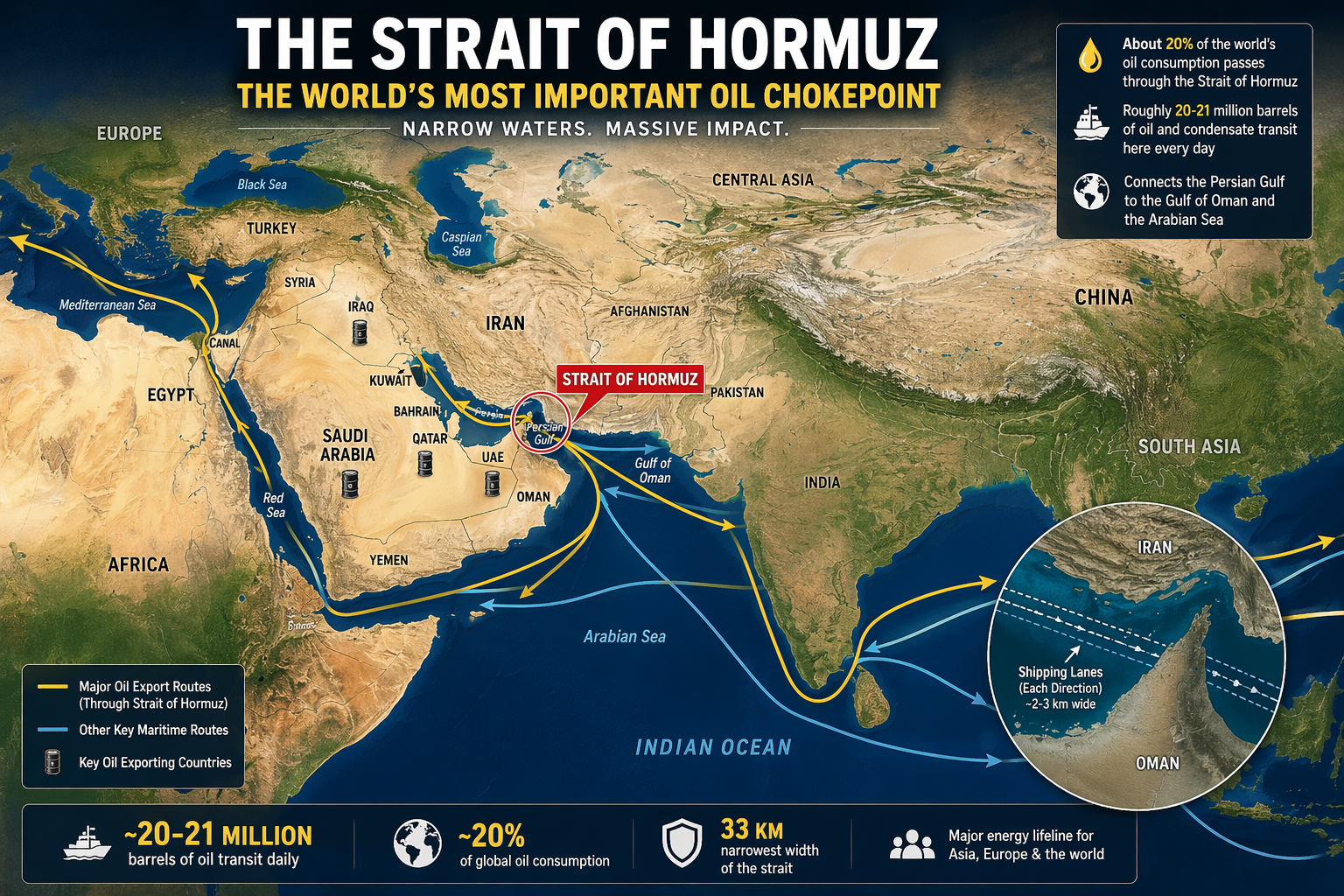

A vast array of tides flow through the Strait of Hormuz, where the Persian Gulf meets the Gulf of Oman. The tides of weather and massive ocean currents that careen off of both Gulf and Ocean shores are certainly the most well known, yet it is the flow of petroleum that course through this approximately few mile wide corridor that can have the most global implications. Since the Strait of Hormuz is the only outlet to the ocean for 20,000,000 barrels of petroleum that flows through the Persian Gulf on a daily basis, any conflict that occurs in the waterway could quickly affect the world and in particular the global energy balance.
Geographic Importance
The Strait of Hormuz is a narrow opening between Iran and Oman with the United Arab Emirates on either side. It is just 33 kilometres wide at its narrowest point, but the actual lanes between the land and the tankers are significantly smaller. The strait is a natural pinch point that is of enormous strategic and vulnerable value.
Massive Oil Transit Volume
The Strait of Hormuz is widely known as a global oil chokepoint due to the enormous volume of oil that is moved through the waterway on a daily basis. The countries with the majority of the world’s oil reserves, Saudi Arabia, Iraq, Kuwait, Qatar and the UAE, all rely on the Strait as a primary route for the export of their oil. Additionally, a large percentage of global oil consumption is dependent on the massive oil tankers that travel through the waterway. Any disruptions to the normal flow of oil in this region could quickly have global consequences.
Lack of Alternative Routes
It has few natural alternatives, no parallel waterway, and no pipeline that can relieve congestion. The existing pipeline system does allow some oil to be moved around the Strait of Hormuz, but it is nowhere near enough to make a meaningful difference. So the Strait acts as a vital bottleneck through which the world’s oil supply must pass.
Strategic and Military Significance
The Strait of Hormuz is one of the worlds most important oil shipping lanes and it has been of considerable interest to super power navies including the US Navy. Due to the present turmoil in the region of concern to the US, involving Iran, there is much concern regarding the possibility of a blockade of the Strait or even armed conflict transpiring. Regardless of size, an incident in this strategic location could easily affect global oil prices.
Vulnerability of a Narrow Passage
The Strait of Hormuz, merely a few miles wide between Iran and Arab neighbors, is a natural chokepoint for the world’s sea-lanes. The likelihood of a mishap, whether a ship running aground or military hostilities, poses a grave threat to the flow of oil and other essential goods for world markets. The impact on trade flows and the consequent economic cost would be enormous.
Global Economic Impact
A thin channel between Iran and Oman known as the Straits of Hormuz is one of the world’s most important oil trade routes, with millions of barrels of oil flowing through it daily. As the global economy becomes increasingly dependent on imported energy, the oil that flows through the Straits ends up in the tanks of major oil importing countries like China, India and Japan. If the Straits were to ever be threatened, it could cause oil prices to skyrocket and create shortages and economic instability here at home, especially for countries heavily reliant on imported energy.
Environmental and Security Concerns
The Strait of Hormuz is an increasingly complex and problematic international shipping lane. Not only do political tensions in the area pose a significant economic threat by potentially restricting one of the world’s most important oil transportation routes, should a serious oil spill occur, the environmental impact on ecosystems could be catastrophic. Moreover, current security affairs, including the possibility of naval conflict, and widespread illegal practices, complicate the proper management of this critical waterway.
Conclusion
The Strait of Hormuz, situated between Iran and the Arabian Peninsula, is one of the world’s most critical oil traffic bottleneck. Because of the small size of the Strait and the difficult geopolitics of the region, it has continued to be a strategic chokepoint to the global oil market. The efforts to find alternative routings to the Strait of Malacca as well as seeking alternative suppliers, however, will keep the Strait of Hormuz very much at the center of any discussion pertaining to global energy security.