
Global atmospheric circulation patterns facilitate the distribution of heat, moisture, and energy across the Earth’s surface and regulate weather, precipitation patterns, storms, and droughts as well as climate zones globally. The atmospheric circulation systems are a collection of interconnected cells, fast flowing streams in the atmosphere, persistent winds, and ocean-atmosphere interactions that together work to balance the amount of energy that is distributed across the Earth’s surface. Global atmospheric circulation systems are being dramatically affected by climate change.
The increasing concentrations of greenhouse gases, particularly carbon dioxide, methane and nitrous oxide in the atmosphere, cause rapid warming of the atmosphere and of the world’s oceans. According to the Intergovernmental Panel on Climate Change (IPCC), the global average surface temperature has already increased by about 1°C since the pre-industrial period and is projected to continue to rise. This warming affects atmospheric pressure systems, the transport and precipitation of moisture, wind patterns and the intensity of atmospheric circulation.
Understanding how climate change affects atmospheric circulation is crucial. This is because global atmospheric circulation affects issues of food, water, ecosystems and natural disasters with far-reaching consequences for human societies and economies around the world.
Understanding Global Atmospheric Circulation
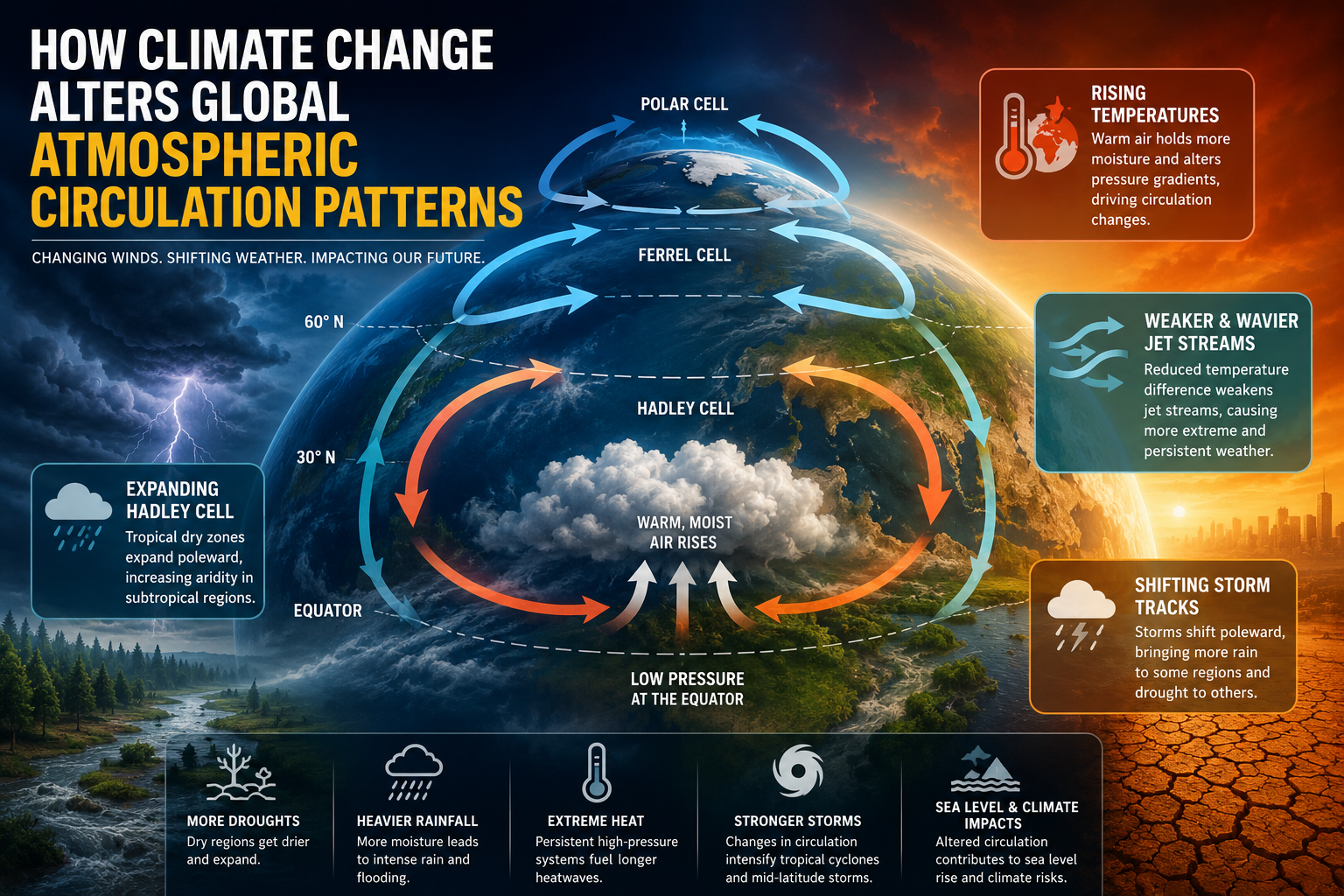
Circulation through the three major circulation cells in each hemisphere; the Hadley Cell, Ferrel Cell and Polar Cell. These are systems that transfer solar energy from the equator towards the poles.
The Hadley Cell
The Hadley Cell consists of circulation between the equator at 0° latitude and 30° latitude. Warm air rises from near the equator, creating low-pressure systems with heavy rainfall. This air then moves poleward in the upper atmosphere and cools as it travels, eventually sinking in the subtropics to create dry, high-pressure systems such as the deserts of the Sahara and the Arabian regions.
The Ferrel Cell
The Ferrel Cell is situated between 30° and 60° latitude. In these temperate areas, the prevailing wind direction is westerly. In these regions, the air from the polar front interacts with the polar air masses bringing about storms.
The Polar Cell
The Polar Cell brings the cold air around the poles down to lower latitudes and back up around 60° latitude where the air rises again.
These large scale circulation systems interact with jet streams, monsoons, storm tracks, and ocean circulation systems. Small changes in these atmospheric circulation systems can have a large impact on local weather and long term climate.
The Role of Climate Change in Altering Atmospheric Circulation
Rising Temperatures and Energy Imbalance
The greenhouse gases in the lower atmosphere (troposphere) trap heat so that the average global temperature goes major way in which climate change alters atmospheric circulation is by changing the energy balance of the Earth. More up. This in turn changes the temperature differences between the equator and the poles, and so modifies
One of the biggest impacts is Arctic amplification – the Arctic is currently warming at a rate of nearly four times faster than the global average. This weakening of the temperature difference between the polar and tropical regions affects the large scale wind systems and jet streams.
A warmer atmosphere can hold more moisture and the IPCC reports that there will be increases of 1% to 3% in global precipitation and evaporation for every 1°C of global warming. As a result, the water cycle on Earth will become more intense with more extreme events of heavy rainfall, increased storm intensity and longer droughts.
Expansion of the Hadley Cell
Poleward Shift of Tropical Climate Zones
One of the atmospheric circulation changes that is very clear with climate change is the expansion of the Hadley Cell. The tropics have been expanding poleward over the past few decades.
More research into the Hadley circulation over the past 30 years or so has revealed that it is expanding. It is estimated that the tropics have moved 0.1° to 0.5° of latitude per decade. These changes are shifting the boundary of the subtropical dry zones into higher latitudes. This means that more of the world is becoming drier and there is a possibility that parts of the world could become much more arid.
In addition to shifting subtropical dry zones into areas that are already dry, but experiencing increased water stress, the expanded Hadley Cell influences total global rainfall and alters storm tracks and related precipitation on a global scale. Regions such as the Mediterranean, southern Australia, the southwestern United States and parts of southern Africa are experiencing increased frequency of extreme droughts and dryness and decreasing amounts of rain.
Effects on Desert Expansion
As the Hadley Cell expands poleward, arid and water-scarce desert regions spread towards the poles. Regions that are already relatively dry but have limited resources to cope with drought and further water deficit experience increased evaporation and decreased precipitation leading to increased aridity.
Th world are predicted for the 21st century by expanding of subtropical dry zones.
Changes in Jet Streams
Weakening and Wavier Jet Streams
A jet stream is a fast moving current of air which is a few hundred kilometers wide and thousands of meters high up in the atmosphere. It is one of the air currents that play a significant role in shaping storm systems and weather patterns. The path that a jet stream typically takes and its behavior is being changed by climate change.
The Northern Hemisphere jet stream has become weaker and more meandering as the Arctic has warmed at a pace greater than the rest of the globe, dramatically reducing the temperature gradient between the polar and tropical regions of the Northern Hemisphere.
This can cause weather systems to remain in one place for longer periods of time, leading to extended periods of extreme heat, floods, droughts, and cold snaps.
Persistent heat domes of extreme heat over North America and parts of Europe have recently been linked to the jet stream’s new behavior brought on by climate change.
Poleward Shift of Storm Tracks
In addition to a weakening Northern Hemisphere jet stream, climate change has also brought about a poleward shift of storm tracks and associated jet stream positions. The resulting changes in rainfall distribution and number of storms impact regions worldwide. In higher latitudes, areas experience increased amounts of precipitation and storms of greater intensity, whereas in the subtropics conditions tend to be drier and experience more frequent changes in weather. These changes have many implications for agriculture, the operation of hydropower plants, and water supply management.
Poleward shifts of storm tracks and associated jet stream positions imply changes in precipitation distribution and storm frequency. While high latitude regions tend to experience more precipitation with more extreme events, regions in the subtropics often tend to get drier. These changes can have significant impacts on agriculture, on hydropower and other water resources.
Impacts on Monsoon Systems
Intensification and Variability of Monsoons
Monsoon systems are closely linked to large-scale atmospheric circulation and the temperature of the adjacent oceans. Changes in climate have already started to affect the timing of the onset, the intensity and the variability of the monsoons.
Warm ocean waters will lead to higher levels of atmospheric moisture, fueling extremely heavy downpours during monsoon seasons, but also leading to increased variability in the climate system causing delayed monsoons, highly variable and uncertain rainfall, and extended dry seasons.
The Indian monsoon that supports to about 20% of the world’s population has of late become more variable in terms of intensity and duration of rainfall.
Increased intensity of rainfall during monsoons can result in serious flooding, landslides, crop damage and failure of urban infrastructure. Conversely, periods of below-normal rainfall can give rise to droughts and food security risks.
Effects on Polar Circulation and the Polar Vortex
Weakening Polar Circulation
The fast warming of the Arctic affects the atmospheric circulation in the Polar Regions and influences the polar vortex. The polar vortex is a circulation of cold air which is stock in the Arctic in the stratosphere.
Arctic warming due to climate change may cause the polar vortex to lose stability. As a result, cold air from the Arctic will move more frequently to mid-latitude regions (North America, Europe and Asia) and cause extreme winter conditions for short periods of time. While globally temperatures are increasing, these extreme events will occur from time to time.
While that the increasing atmospheric instability in the polar regions due to climate change is making the polar vortex less stable.
Ocean-Atmosphere Interactions
Influence on ENSO and Walker Circulation
The atmosphere and the oceans are part of a large climate system that interacts with each other. This interaction especially affects the ocean-atmosphere interactions like the El Niño–Southern Oscillation (ENSO) and the Walker Circulation.
The Walker Circulation refers to the east-west atmospheric circulation that is confined to the tropical Pacific Ocean. The large scale Walker Circulation affects rainfall in Asia, Australia, Africa and the Americas.
Some climate models further predict that warming of the oceans could bring about a weakening of the Walker Circulation. This in turn could bring about an increase in extreme events of El Niño and La Niña.
Changes well as the distribution and abundance of fish and other aquatic resources and the productivity of agriculture worldwide.
Increased Extreme Weather Events
Stronger Heatwaves, Floods, and Storms
Changes in atmospheric circulation have contributed to an increase in extreme weather and climate events. Such events are often associated with slower moving weather systems, higher atmospheric moisture, and altered pressure patterns.
Studies found that the atmosphere now even contains 7% more moisture for every 1°C of warming, in accordance to the Clausius-Clapeyron relation. This additional moisture, among others, can lead to very heavy and extreme rainfall as well as more extreme storms.
Persistent high pressure means that the air is stuck for longer and leads to extreme heat and drought for extended periods of time. This can bring record breaking heatwaves as well as droughts.
Long-Term Consequences for Human Society
Agriculture and Food Security
Droughts and extreme weather conditions that could lead to a decline in crop yields for vulnerable countries could be as a result of changes in atmospheric circulation bringing about changes in rainfall, heat and water.
Water Resources
In many parts of the world fresh water for the population is depending on precipitation in a certain and predictable pattern, which is determined by atmospheric circulation. Changes in the position of storm tracks or in the behavior of monsoons can have devastating effects on populations that rely on these water resources.
Ecosystems and Biodiversity
irculation changes caused by climate change have far-reaching effects on habitats, animals’ migration routes and processesC from new climate zones.
Economic and Infrastructure Risks
It is now increasingly evident that changes in atmospheric circulation are responsible for an increase in extreme weather events, leading to increasing economic losses world-wide. Floods, hurricanes, wildfires and heatwaves cause severe damage to the infrastructure of a country and affect labor productivity and public health services.
Scientific Uncertainty and Ongoing Research
Although and uncertain aspects of the atmospheric system. Natural variability, volcanic, solar and oceanic processes all play there is a large amount of evidence that climate change is altering the atmospheric circulation, there are many complex a part.
Improving climate models to project future changes in the jet stream, monsoons, storm tracks, and the intensity of atmospheric circulation is an area of ongoing research. While there are many uncertainties involved in the study of atmospheric circulation, the evidence is clear that human-induced warming of the planet is having a significant impact on the Earth’s atmospheric circulation systems.