
Climate change is no longer a problem for the future; it already affects millions of people worldwide. Higher temperatures, more extreme weather and climate events like droughts and heavy rainfall as well as the rise of the sea affect cities and their inhabitants. For some cities the impacts of climate change will be even more severe in 2026 than for others – depending on location, population density, physical exposure, infrastructure and economic development.
A number of cities around the world are urban centers that face extreme risks from effects of climate change but do not have the financial means or the physical resilience to cope and adapt to a changing climate. Some are affected by regular flooding and extreme heat while others are affected by tropical cyclones, droughts, water shortages, and coastal erosion. In many cases, the same city will be affected by more than one of these types of climate change impacts. In order to provide those with an interest in cities around the world—policy makers, businesses, investors, and individuals with ties to urban areas—information on the types of cities that are most vulnerable to climate change, Climate Change Vulnerability of Cities, the report identifies the most vulnerable cities in the world.
Climate vulnerable cities are not limited to one part of the globe, instead they are found in every continent, including Asia, Africa, North America, South America, Europe and Oceania. Most of the highly exposed and sensitive cities are however found in developing parts of the world where high population growth rates are often combined with structural weaknesses of aging urban infrastructure and with an general lack of financial, human and technological resources to develop adaptation capacities.
Understanding Climate Vulnerability
When determining climate vulnerability, three factors need to be taken into account: exposure, sensitivity and adaptive capacity. Exposure refers to the extent to which a city is exposed to climate-related hazards, such as floods, hurricanes, droughts or heat waves. Sensitivity measures how a city and its inhabitants can be affected by these climate-related hazards. Adaptive capacity refers to a city’s ability to adapt to climate-related changes in advance (proactive) and/or to cope with and recover from climate-related impacts as and when they occur (reactive).
In coastal flood plains with rising sea levels, high exposure to the effects of climate change can be increased by high sensitivity and low adaptive capacity of the city, for example, through large numbers of inhabitants in informal housing, lacking in flood protection. Also a lack of financial resources of government and of investments in infrastructure to cope with effects of climate change can lead to high vulnerability of a city.
Many organizations (The United Nations, The World Bank, The Intergovernmental Panel on Climate Change (IPCC) and many more climate research institutions) use these factors to determine the climate risk in cities around the world.
Why Cities Face Growing Climate Risks in 2026
More than half of the global population lives in urban areas and keeps growing. Many cities have been established near coasts, rivers and fertile plains and were therefore conducive to trade, transport and economic success in the past. Today, however, these are also the areas where the greatest climate-related risks are located.
On average the Earth’s temperature has increased by about 1.2°C over the pre-industrial era, bringing with it more frequent natural disasters such as droughts, heat-waves, floods and landslides. As a result of climate change the world’s oceans have also expanded due to thermal expansion and glaciers and ice sheets have retreated leading to a global average sea level rise of about 15cm, increasing the risk of coastal flooding. Some areas are also experiencing more extreme and longer lasting heat-waves.
The growing population further adds to the problems caused by extreme climate events, as the increased number of people, businesses and structures in exposed areas can lead to high damage costs and severe consequences for affected people.
Jakarta, Indonesia: The Sinking Megacity
In 2026 Jakarta is again one of the world’s most climate vulnerable cities. With over 11 million people living within the city boundaries of the capital of Indonesia and some 30 million people living in the metropolitan area climate change as well as other changes caused by humans, pose a huge number of challenges to the city.
Severe land subsidence due to excessive groundwater extraction affects parts of Jakarta to such an extent that in some locations land has even sunk by several meters in the past decades. Adding to the already existing rise of sea levels, extreme rainfall during the monsoon seasons leads to an immense increase of flood occurrences in the city.
40 percent of Jakarta is already below sea level and, here, seasonal flooding afflicts not only the local residents but also streets, companies and public transportation systems. The decision to move the capital to Nusantara is in part a recognition of the challenges which Jakarta will continue to face in the coming decades unless major investment is made in effective flood protection measures and in sustainable water management.
In the coming decades, climate risks for Jakarta will continue to increase unless adequate flood protection and sustainable water management measures are developed and implemented.
Dhaka, Bangladesh: Extreme Population Pressure and Flood Risk
Dhaka is one of the most climate-exposed cities worldwide. As the capital of Bangladesh it is situated in the world’s largest river delta and thus is extremely exposed to the risk of flooding, of cyclones as well as of heavy rainfall.
Dhaka, the capital of Bangladesh, is home to 20 million plus people residing in clusters of densely populated neighborhoods. Climate change is increasing the frequency of extreme rainfall and thus the city’s exposure to flooding.
There have been great strides made in disaster preparation in recent years with a significant decrease in mortality due to cyclones, however the urbanization of cities and continued pressures from climate change are putting a huge amount of stress on the infrastructure, housing and public services of these locations.
A significant proportion of climate displaced people who have moved from coastal areas to other parts of the country are moving to Dhaka and are putting a lot of pressure on the city and its infrastructure as it already is one of the most densely populated cities in the world.
Miami, United States: Rising Seas and Coastal Threats
As one of the most vulnerable major cities in the United States, Miami is at high risk from the effects of sea-level rise, storm surges, tidal flooding and extreme hurricanes. In South Florida, where the coastal area is low-lying, these effects are likely to increase over time.
Unlike many coastal cities, Miami sits on top of porous limestone bedrock. This unique geology means that even behind a sturdy sea wall, seawater can leak down into the ground and cause flooding. The challenges to adapting to sea level rise in Miami are particularly complex as a result.
Day-to-day flooding from high tides has become a more common occurrence and has brought increased attention to the factors that affect the cost of insurance, the price of constructing new infrastructure, and the value of real estate in South Florida.
The challenge of sea-level rise is likely to be one of the most significant issues facing the City of Miami in the 21st Century.
Lagos, Nigeria: Rapid Growth Meets Climate Challenges
Lagos is the largest city in Africa. The metropolitan region of Lagos consists of more than 20 million people and is one of the fastest-growing urban regions in the world.
As the largest city in Africa and rapidly urbanizing, Lagos faces several immediate climate change threats as a coastal city on the Atlantic including coastal erosion, flooding (including tidal and rain-induced) and projected sea-level rise as well as increasing variability and frequency of extreme rainfall events. As the greatest threat falls on the urban poor who reside in informal settlement with limited provision for drainage, inadequate housing, poor living conditions and limited access to basic services, much of the urban climate change resilience work will have to be focused on enabling these groups of people to improve their living conditions and reduce their vulnerability to extreme weather events.
Given the economic importance of Lagos beyond Nigeria, improving climate change resilience will be crucial for the development of the region as a whole. Large investments are expected in the area of flood management as well as in adequate transportation and coastal protection in order to guarantee the future climate resilience of the metropolitan region of Lagos.
Manila, Philippines: Typhoon Exposure and Urban Flooding
As one of the most disaster-prone cities in the world, Manila faces great challenges as it is located in a tropical region that is frequently hit by tropical cyclones and affected by climate change. As such, the city is susceptible to a variety of natural hazards such as typhoons, storm surges, extreme rainfall and sea-level rise.
The Philippines is affected by around 20 tropical cyclones each year, with a portion of these tropical cyclones making landfall. Manila, with its highly urbanized setting and coastal location, is specifically susceptible to the occurrence of flooding brought about by such extreme weather events.
The city’s vulnerability stems from climate change bringing heavier downpours and more intense tropical storms, which put an additional strain on drainage systems, roads, and buildings across the city.
Therefore, an integrated urban planning and climate adaptation approach is necessary for Manila to decrease its vulnerability.
Karachi, Pakistan: Heatwaves and Water Stress
Heat and water scarcity are the principal climate change challenges facing Karachi, Pakistan’s biggest city. With temperature over the summer months often reaching well above ‘dangerous’ levels, the city is frequently afflicted by extreme heat events.
In addition to challenges such as water scarcity, growing population and inadequate infrastructure, Karachi also faces threats of extreme climate change-related weather events. Climate change is projected to increase the frequency and intensity of heatwaves across South Asia in the coming years and pose grave risks to public health.
Much worse is in store for this massive city, which currently is home to 18 million people. Already slight changes in the climate could affect millions of them when they occur. To this end, urban cooling as well as water- and emergency management need to be improved.
Alexandria, Egypt: Threatened by Mediterranean Sea-Level Rise
Alexandria is one of the oldest cities still continuously inhabited in the world and one of the climate risk exposed cities in the Mediterranean region.
The city is threatened by the impacts of sea-level rise, including increased flooding, salt-water intrusion into underground fresh-water aquifers and erosion along the coast. As one of Egypt’s economic centers and a transportation hub, as well as a culturally and historically significant location, the city of Alexandria faces great challenges for its protection and for its long-term climate change adaptation.
Even a slight rise in sea levels is expected to have impact on a large part of the Nile Delta where millions of Egyptians live and produce a large share of the country’s agricultural production.
Protecting the City of Alexandria requires huge investment in shore line protection and climate change adaptation over the long term.
Ho Chi Minh City, Vietnam: A Delta City at Risk
Ho Chi Minh City, Vietnam’s largest economic center and one of the climate vulnerable cities in Southeast Asia, is facing more challenges from climate change impacts as it is located in Mekong Delta, the lowest area of Vietnam and suffering from serious land subsidence while sea level is rising. The city suffers from more and more serious floods due to climate change impacts, such as heavy rainfall, sea level rise and land subsidence.
Home to millions of people and key agricultural production the Mekong Delta is under threat from impacts of climate change which will continue to pose challenges to urban development and food production systems.
With the economic development of the city, the challenge of city planners and policy makers is to develop the city while enhancing climate resilience.
Kolkata, India: Flooding, Heat, and Cyclone Risks
Kolkata continues to remain vulnerable to a range of climate change impacts. As a city on the Bay of Bengal and within the Ganges Delta, it is exposed to the risk of cyclones, flooding, heat and heavy rainfall.
There are approximately 15 million people living in the larger metropolitan area and while climate change is increasing the frequency of intense precipitation events it is also causing temperatures to rise.
The urban heat island; aging and failing physical infrastructure; and extreme population density all present a host of additional risks to which Kolkata must develop the appropriate and sustainable measures of resilience to protect its citizens and economy.
Amsterdam and Rotterdam: Managing Climate Risks Through Adaptation
Many vulnerable cities face the challenges of climate change while struggling with the lack of financial, human and technical resources. However, there are also examples of successful climate change adaptation. This also applies to Amsterdam and Rotterdam, two cities in the Netherlands that are heavily exposed to sea level rise as most of the country’s surface is at or below sea level.
For decades, the Netherlands has invested in flood defenses and water management systems and in climate change adaptation. Although vulnerable due to a large part of the country being at or below sea level, Amsterdam and Rotterdam show how climate change can be reduced. Their experience with advanced engineering, storm surge barriers and new urban planning provides lessons for other coastal cities in the world.
While Amsterdam and Rotterdam are powerless against the tides in their current situation, their experiences show that vulnerability is more than a matter of geography. It is also a function of preparedness and good governance.
The Economic Cost of Climate Vulnerability
Climate change is bringing more and more economic repercussions. Weather-related disasters are costing the global economy hundreds of billions of dollars per year according to insurance and disaster assessment agencies around the world.
Urban flooding causes damage to traffic, buildings, shops and businesses. In addition, it can disrupt production and cause loss in the chain. It can put a large burden on a city’s finances for a long time. Besides urban flooding, extreme heat already causes significant losses, for instance in terms of productivity, in terms of extra energy consumption and of extra pressure on health care.
For very vulnerable cities, climate adaptation is becoming a matter of economic survival rather than environmental choice. The investments that a city makes today will significantly reduce its losses in the future and increase its resilience in the long term.
Climate Migration and Urban Challenges
One of the key trends affecting vulnerable cities is climate migration. Climate change contributes to the rise of seas, to droughts and harvest failures, and to extreme weather events. Sometimes people are forced to move as a result of natural disasters, and at other times they choose to migrate to cities in search of safety or better economic opportunities.
These people travel to urban centers within their own country or to other countries in search of safety or better economic opportunities. Many cities offer better services and more job opportunities than rural areas. However, rapid urbanization puts a huge burden on the housing market and on infrastructure for transportation, health and public services.
The effective management of climate migration will become a major challenge for governments in the decades to come.
How Cities Are Building Climate Resilience
Innovative strategies to mitigate climate change are being developed and implemented by many cities. Constructing sea walls, restoring wetlands, better managing rainwater through improved drainage systems, creating urban green spaces, developing and upgrading infrastructure, as well as preparing for emergencies are examples of actions taken by many cities around the world.
Nature-based solutions are getting increasing attention, as they have multiple benefits: Wetlands, mangroves, urban forests and even green roofs can prevent flooding, improve air, lower temperature and even enhance biodiversity.
Advances in climate monitoring, early warning systems and management of urban infrastructure can also help cities deal with the challenges of climate change.
P.S.
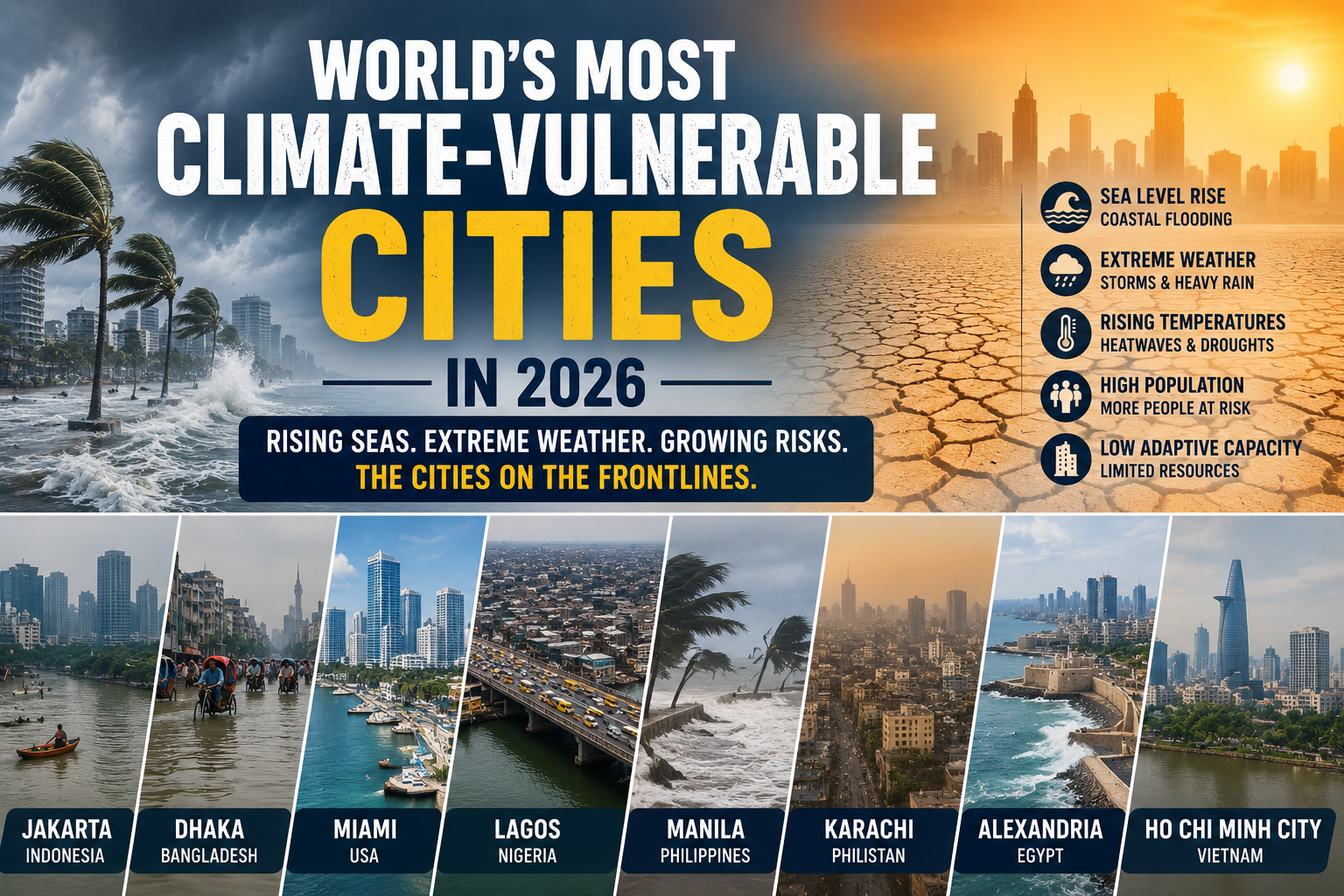
This new ranking of the world’s most climate-vulnerable cities in 2026 highlights the challenges that climate change poses for urban areas worldwide. Of the cities analyzed, Jakarta, Dhaka, Miami, Lagos, Manila, Karachi, Alexandria, Ho Chi Minh City, and Kolkata are the most exposed to flooding, sea level rise, heat, storms and water scarcity.
While these risks are severe, vulnerability is not destiny. Cities can reduce their exposure to climate change impacts through effective planning, strong infrastructure, scientific research, community participation, and long-term investment. As climate change continues to reshape our world, the actions that cities take today will determine their ability to safeguard their populations, economies and the future.
Understanding climate vulnerability is key to effective climate action and planning for the future. Governments, urban planners, businesses, investors and citizens all can learn from the world’s most vulnerable cities on how to adapt to climate change, how to increase their resilience and why climate action on a global scale is needed now more than ever.