
Rising sea levels are one of the most visible and serious effects of climate change. Sea levels are rising due to the melting of glaciers and ice sheets worldwide as well as the thermal expansion of the oceans that cover most of the planet. In Greenland and Antarctica, the latter is particularly dramatic, with huge chunks breaking off of the ice sheets in recent years. What used to be a relatively obscure environmental issue is now affecting the lives of millions of people worldwide.
According to the climate change panel the Intergovernmental Panel on Climate Change (IPCC), global sea levels have already risen by around 20 centimeters or 8 inches since the year 1900. The current rate of sea-level rise has significantly increased during the last decades. By means of satellites it can be seen that at present the global sea level is rising by more than 4 millimeters per year and thus is about double the rate of the 20th century.
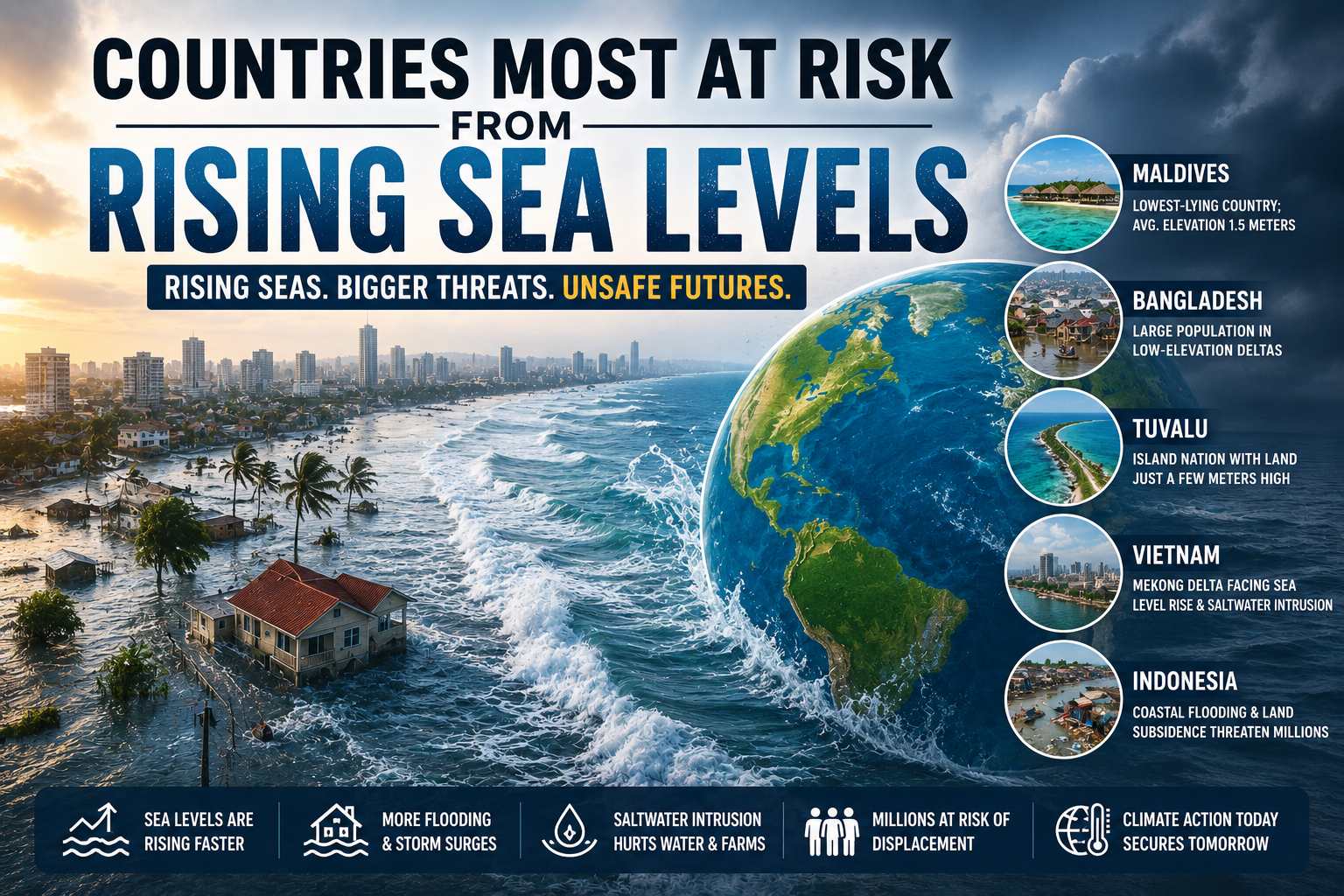
In addition to flooding coastlines with saltwater, higher sea levels can flood homes and buildings, contaminate freshwater sources, destroy farmland and decrease tourism, devastate ecosystems and even threaten a country’s very existence. In some cases a significant part of a country could be lost while in other cases it could cost billions of dollars to protect the home of its people and businesses.
To help many groups of people to deal with the coming sea level changes it is important to know which countries are most exposed to sea-level rise.
Why Sea Levels Are Rising
There are two main processes causing sea-level rise, both linked to global warming. Firstly, the world’s glaciers and ice sheets are melting at an exponential rate as the planet warms. The two largest such reserves of frozen water, the Greenland Ice Sheet and the Antarctic Ice Sheet, contain enough to raise global sea levels by many meters.
Seawater also expands when it heats up. This thermal expansion has already contributed to a substantial portion of the sea-level rise during the past 100 years.
Studies suggest that by 2100 global sea levels may rise between 0.3m and 1m (1ft to 3.3ft) with greater increases possible under worst case scenarios, and dependent on factors including future emissions of greenhouse gases, climate change policies and the response of ice sheets to warming.
These numbers seem to be quite low, however, a small increase in the sea level can cause a huge increase in the amount of coastal flooding, erosion and damage from storm surges.
How Sea-Level Rise Creates Risks
Climate change and especially sea-level rise affect countries in many ways. On the one hand, the land is overfloded more and more due to higher sea levels and by storm surges that penetrate deeper into the land. On the other hand, already during normal high tides low-lying areas and coastal cities all over the world are affected by flooding.
Saltwater is entering into the aquifers which supply us with fresh water, farmland is being salinized which will reduce agricultural production, and the fresh water supplies to support the drinking water supplies of coastal cities are being threatened. In addition to the impact of flooding to structures along the coast, erosion of shorelines is becoming more severe, exposing ports, airports, roads, power plants and other critical facilities to be lost as the coast continues to retreat.
Impacts can have a large economic effect and result in loss of income and even of life. In many developing countries tourism forms the base of their economy and is often concentrated on beaches and along the coast. The impact of flooding and erosion on agriculture can also be severe due to soil salinization. In addition, the increased risk of flooding can lead to increased premiums for insurance against natural hazards.
For small island developing countries, the challenge posed by sea-level rise is existential in nature as whole populations and entire ecosystems could be forced to relocate as lands and habitats become uninhabitable.
Maldives: One of the World’s Most Vulnerable Nations
The Maldives is often called the country most threatened by the rising of the sea. The Maldives are a chain of about 1,190 coral islands and are spread over 26 atolls in the Indian Ocean.
The average height of a Maldivian island is 1.5m (5ft) or less above sea level and more than 80% of the landmasses have a height of less than 1m (3.3ft) above sea level, which makes the Maldives the lowest country on earth.
More than 500,000 people live in the Maldives and most of their economy is based on Tourism. The threat from coastal flooding, erosion and the invasion of salt water into brackish water aquifers and freshwater reservoirs has the potential to destroy much of the country’s critical infrastructure and fresh water supplies and will present very real challenges to future development.
The government of the Maldives is currently spending vast sums to protect the coast with sea walls, including a 500 meter long wall around the capital, Malé. However, in the long term, it is likely that the country will be unable to adapt to the projected rise in sea levels.
Tuvalu: Facing an Existential Threat
Tuvalu is one of the most vulnerable countries facing sea level rise with a population of approximately 11,000 living on nine extremely low-lying coral atolls spread across 26 square kilometers of land with much of the land less than 5m above sea level.
Tuvalu has 9 Islands, all very low-lying with average height of only a few meters above sea level. As a result, many areas and assets are subject to periodic flooding, including normal tides and occasional king tides.
Many islands face problems with saltwater entering wells and contaminating water supplies, but for Tuvalu, the effect of climate change on its ability to produce and store enough food is its biggest concern. The country has become one of the leaders in the preservation of its culture and language online by using digital preservation projects such as the Tuvalu Preservation Society. Many of the country’s archives are at risk of destruction from sea level rise, and these online projects mean that future generations will still be able to read about the history of Tuvalu, even if the country is no longer on the map.
For many people in Tuvalu, sea level rise is a current issue rather than something that is happening in the future.
Kiribati: Preparing for an Uncertain Future
Another Pacific island nation, Kiribati is made up of 33 coral atolls spread over a vast area of the Pacific Ocean. Most of Kiribati’s islands are only a few meters above sea level.
With many of the islands only meters above sea level Kiribati has become known internationally for its vulnerability to sea-level rise, coastal erosion, salt-water contamination of freshwater resources and challenges for long-term habitability on South Tarawa where the vast majority of the population are resident.
In response to the risks that Kiribati faces with sea-level rise, the government is currently implementing a number of adaptation projects. These include the implementation of a range of coastal protection solutions as well as a number of land reclamation projects. In addition the country is working with a range of international partners to build up its climate change resilience.
Sea-level rise poses significant social, economic and cultural risks to future generations of Kiribati citizens.
Bangladesh: Millions Living in Vulnerable Coastal Areas
As a very low-lying country with huge population, Bangladesh is extremely climate vulnerable. The country is exposed to tropical cyclones, which in recent years, have been made more intense by climate change.
South Asian island nation in the tropics; Bangladesh is situated in the lower reaches of the Ganges-Brahmaputra-Meghna River Delta, which is one of the world’s largest; Southern part of the country is only a few meters above sea level.
With over 170 million people living in Bangladesh, tens of millions of those living in coastal areas are at risk from flooding, storm surges and sea level rise. Even relatively small increases in sea level could lead to large areas of agricultural land becoming inundated, potentially forcing many people to flee their homes.
Bangladesh is a global leader in climate adaptation with a significant investment in cyclone shelters, a high-end flood forecasting system and large programs of work along the coast. However, the long-term impact of rising seas will continue to present many challenges for the country.
Netherlands: Living Below Sea Level
The Netherlands is, on a global scale, a special case when it comes to rising sea levels. One third of its land is situated below sea level and two thirds of the Dutch population lives in areas that are prone to flooding.
Unlike many other vulnerable countries the Netherlands is a country with huge resources and with a lot of experts in the field of water management. For centuries Dutch engineers have constructed dikes, levies, storm surge barriers and sophisticated drainage systems to keep flooding at bay. Big cities as Amsterdam, Rotterdam and The Hague depend on these protection systems.
Major cities such as Amsterdam, Rotterdam and The Hague rely on these systems to protect their population. Increased pressure on these structures and systems as a result of climate change will require the Netherlands to continue to invest in the adaptation and the increase of its resilience.
With adequate planning and clever engineering, a large degree of vulnerability can be prevented.
Vietnam: Threats to the Mekong Delta
Rising sea levels pose significant risks to Vietnam. The Mekong Delta with millions of people and the hub of Vietnam’s agriculture, producing most of the world’s rice, is one of the most sensitive areas to sea level rise, land subsidence and saltwater intrusion affecting the agricultural production and the supply of fresh water.
With millions of people residing in the region and a large contribution to the national economy through agriculture production, the impacts of sea level rise, land subsidence and saltwater intrusion into freshwater resources are already felt.
However, the fast growing economic center of Vietnam, Ho Chi Minh City, is also exposed to flooding and the impact of the rising sea level. Climate change has become a national priority for Vietnam in terms of adaptation in order to protect population and assets.
Egypt: Risks in the Nile Delta
The Nile Delta in Egypt, one of the most densely populated parts of Africa, is also home to a large proportion of the country’s agricultural land and food production, which is intended for the tens of millions of people living in the area.
Rising sea levels and related impacts threaten to inundate many of Egypt’s coastal cities including historic Alexandria. In the Delta, threats of sea water intrusion into underground fresh water aquifers, of erosion and flooding of agricultural land, buildings and other infrastructure, pose major challenges to agricultural production and to urban and rural communities alike.
Given the limited amount of arable land in Egypt and the rapidly increasing population, the protection of the Nile Delta is of the highest importance to secure future food production and to maintain economic development.
Indonesia: Coastal Cities Under Pressure
Spread over more than 17,000 islands in Southeast Asia, Indonesia is grappling to come to terms with various challenges posed by sea level rise. Many of its major cities are found along the country’s vast coastlines.
As a global leader in climate change, Jakarta is facing various challenges with sea level rise as well as land subsidence mainly caused by massive extraction of groundwater. The subsidence in some areas is even happening at a rate faster than the sea level rise, leading to increased flooding in the city.
Moving the capital from Jakarta to Nusantara is one of the challenges Indonesia needs to deal with in the long run to tackle environmental and infrastructure problems in the country.
United States: Rising Risks Along Thousands of Miles of Coastline
The United States faces sea-level rise-related risks in the Atlantic Coast, the Gulf Coast, the Pacific Coast, and Alaska.
In Florida, with its very low elevation and large amount of coastal development, Florida cities such as Miami, Miami Beach, Tampa, and Fort Lauderdale are already experiencing frequent tidal flooding events.
In Louisiana, where land loss is occurring at a rapidly accelerating rate, thousands of square miles of wetlands are disappearing, and coastal erosion is eating away at the edges of the state. The city of New Orleans and other coastal communities remain extremely vulnerable to flooding from both storm surge during hurricanes and from rainfall within the city itself.
The National Oceanic and Atmospheric Administration (NOAA) projects that sea levels will continue to rise throughout this century along the coastlines of the United States putting the homes of millions of U.S. residents at risk of flooding.
Small Island Developing States Face the Greatest Threats
Small Island Developing States (SIDS) are among the countries most threatened by rising sea levels. These are mostly island and coastal countries with limited land, small economies and accordingly little means to finance necessary measures of adaptation and to carry out large-scale projects of migration.
Unlike larger countries, the limited land area of many SIDS, their small economies and limited financial resources, mean that there are few alternative locations for those who need to relocate as a result of sea-level rise. Furthermore, there are few funds available to support the types of large-scale adaptation and protection projects that are often required to protect low-lying island nations from climate change. As a result, climate finance and international cooperation play important roles in helping to support countries to increase their resilience to climate change.
The challenges faced by SIDS are increasingly becoming central issues in climate change negotiations and in international development cooperation.
Economic Consequences of Rising Seas
The financial implications of sea-level rise could be huge. Coastal areas account for a significant proportion of Global GDP, through ports, tourism, fisheries, manufacturing and trade.
Estimates of flood damage, repair of infrastructure, insurance claims and costs of relocation for affected populations run into the trillions of dollars over the coming decades. Sea level rise could necessitate costly upgrade of major ports around the world to keep them operational and capable of handling international trade.
The value of property located in vulnerable coastal areas is decreasing as the exposure to climate related risk is better understood. Many businesses are conducting a climate change risk assessment and taking this into account when deciding where to locate or invest in the long term.
Climate Migration and Population Displacement
Rising sea levels pose unprecedented challenges to human populations around the world. As sea levels continue to rise, flooding and erosion of coastlines will lead to the permanent loss of habitable land and force millions of people to migrate temporarily or permanently within a country or to another country.
While migration has always been a part of human history, climate change will make environmental pressures rise. As a result, climate change displacement is expected to become more common.
Governments, humanitarian organizations and institutions around the world are trying to better understand the challenges of climate change and to prepare for them. By developing effective strategies for migration in the face of climate change, it is possible to reduce the negative impacts and support people affected by climate change.
Adaptation Strategies and Solutions
Countries and cities are designing strategies to reduce impacts from sea level rise. Coastal protection with seawalls, levees and storm surge barriers are common solutions, but nature-based solutions are increasingly recognized for their benefits as well.
Nature-based solutions have recently gained much attention in reducing sea-level rise impacts. Such solutions include restoring Mangrove forests, protecting wetlands and coral reefs as well as other natural coastal barriers and undertaking beach nourishment projects that help to absorb wave energy thereby reducing erosion impacts.
Additionally, improved urban planning, climate-resilient infrastructure, and early warning systems for extreme weather events as well as sustainable water management all play a crucial role for the implementation of adaptation strategies worldwide.
The effectiveness of all these measures depends on local circumstances, financial means and the long-term commitment of politics.
P.S.
Rising sea levels are one of the biggest challenges that face humanity in the 21st century. Some countries such as the Maldives, Tuvalu, Kiribati, Bangladesh, Vietnam, Egypt, Indonesia, the Netherlands and the United States face increased risk of coastal flooding, erosion, saltwater intrusion and population displacement.
While the extent of the impacts varies from country to country, the trends are clear: sea levels are rising and the effects are becoming increasingly visible. Some countries are facing the very real threat of losing land, even disappearing, while others will need to invest heavily in order to adapt to the changing climate in order to protect their populations and economies.
The future of many countries depends on two things: Reduction of Greenhouse gases on a global scale and Climate Resilience on a local scale. Therefore it is important to know which countries are most at risk and how to protect the populations, the economy and the environment in times of rapidly increasing environmental changes.