


Earth’s rotational patterns continue to be studied because they deliver vital data which scientists need for their work in geophysics and climate science and timekeeping systems. Earth’s rotation speed is not constant; it varies over both short and long timescales due to a combination of natural and human-induced factors. The article examines evidence together with causes and effects by utilizing official sources which include NASA and USGS and the International Earth Rotation and Reference Systems Service (IERS). The content draws its information from peer-reviewed studies and official scientific data which ensures both accurate and trustworthy information.

Long-Term Changes in Earth’s Rotation Speed
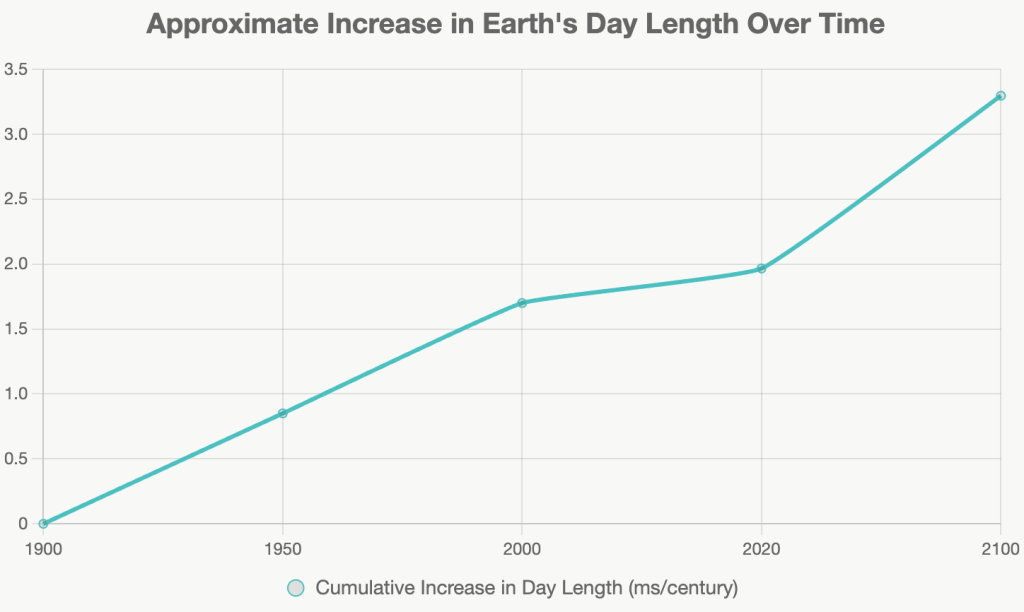
Earth’s rotational speed has decreased throughout geological periods which resulted in extended durations of daylight. Historical records from ancient eclipses and astronomical observations indicate that the length of a day has increased by about 2.3 milliseconds per century since the 8th century BCE. Atomic clocks enable scientists to measure time with higher accuracy which reveals that the present day extends 1.7 milliseconds beyond what it was during the previous century. The Earth’s rotation has become slower because of tidal friction which the Moon creates through its gravitational force that converts Earth’s rotational energy into Moon’s orbital energy thus extending the length of a day.
Scientists who study fossils of tidal rhythmites and stromatolites have proven that Earth experienced 21-hour days when the planet was 600 million years old. The Precambrian era experienced unchanging day lengths because its atmospheric tides operated at the same rate as lunar tides through a process of resonant stabilization until glacial temperature changes broke this equilibrium. The Earth’s rotation has slowed down through millions of years until it reached its present sidereal day duration of 23 hours 56 minutes 4.1 seconds.

Short-Term Variations in Rotation Speed
The rate of Earth’s rotation has experienced different patterns throughout recent decades because it has both slowed down and speeded up. Since 2000, the rate of day lengthening has accelerated to about 1.33 milliseconds per century, faster than any point in the previous century (where rates ranged from 0.3 to 1.0 milliseconds per century). The Earth’s rotation speed has experienced occasional brief acceleration which produced minimal 2025 summer day shortening of less than one millisecond. The shortest day in recorded history took place on June 29, 2022 when the day became 1.59 milliseconds shorter than a standard 24-hour period.
The different patterns in this phenomenon occur at intervals which span seventy years while the inner core spin rate determines the total speed of the phenomenon. USGS and NASA studies confirm that the inner core began slowing around 2010, now moving backward relative to the surface. The cyclic variability pattern follows a 25–30 year cycle which leads to speed decreases that occur every five years.
Causes of Changes in Rotation Speed
Tidal friction stands as the main long-term factor which causes Earth’s rotation to slow down because the Moon’s gravitational force produces ocean bulges that redirect Earth’s rotational energy (Earth’s angular momentum decreases at a rate that depends on the Moon’s distance from Earth to the power of -6). The last ice age caused Earth mass to shift across its surface through post-glacial rebound which also altered its rotational inertia.
Short-term changes are driven by:
- Climate effects: The Earth becomes more spherical because ice sheet and glacier melting and groundwater depletion create a mass transfer from polar regions to equatorial areas which also causes Earth’s rotational speed to increase because of angular momentum conservation. NASA-funded research shows 90% of polar motion fluctuations (Earth’s spin axis wobbling by about 10 meters between 1900 and 2018) are due to these processes.
- Geophysical events: The 2004 Indian Ocean earthquake produced a 3 microsecond day shortening because it decreased the planet’s moment of inertia. The Three Gorges Dam along with other human activities extended day length by 0.06 microseconds.
- Core-mantle coupling: Interactions between Earth’s liquid outer core and mantle cause amplitude variations of about 5 milliseconds in length of day.
Implications of Changes in Rotation Speed
The modifications create operational requirements for UTC timekeeping because scientists need to insert leap seconds to match atomic time (UT1). The system has received 27 leap seconds since 1972 but scientists now consider adding a negative leap second for 2029 because of current timekeeping acceleration. The USGS shows that J2 (Earth’s oblateness coefficient) experiences a decrease because of tidal friction and postglacial rebound which modifies Earth’s rotation speed. The system requires precise measurement of all time variations which include microsecond level changes.
Human activities which cause climate change are making the planet experience longer months at a rate which will surpass natural lunar cycle variations during the next century when greenhouse gas emissions continue to increase. The exact timing requirements of global technologies would face disruption because of this development.
Final Words
The Earth’s rotational speed experiences two different patterns of change because tidal forces and rebound processes lead to long-term speed reduction but climate-related mass movements and core activities produce short-term speed increases. The different measurement results show how Earth’s natural