

Introduction: A Rapidly Changing Magnetic Planet
The Earth maintains its magnetic field as a vital natural system which defends life from dangerous solar radiation while providing navigation capabilities for all environments. Scientists have documented Earth’s magnetic pole movement since ancient civilizations first observed this process which occurs at a slow pace across multiple centuries. Scientists have made new discoveries which show that the magnetic poles especially the magnetic north pole are shifting at an unprecedented rate. Scientists around the world now study this fast Earth movement because they want to understand what is occurring beneath the planet’s surface and whether these changes indicate a major shift in Earth’s magnetic system.
Understanding Earth’s Magnetic Poles
The Earth contains two sets of poles which include geographic and magnetic poles that function independently from each other. Earth’s rotational motion creates fixed points which define geographic poles but magnetic poles exist as active locations which the planet’s magnetic field determines. Magnetic poles shift because the magnetic field itself is generated by moving molten metal inside the Earth rather than by a fixed internal magnet. As a result, the positions of the magnetic poles are constantly changing, though historically this movement was relatively slow and predictable.
The Origin of Earth’s Magnetic Field
The Geodynamo in the Outer Core
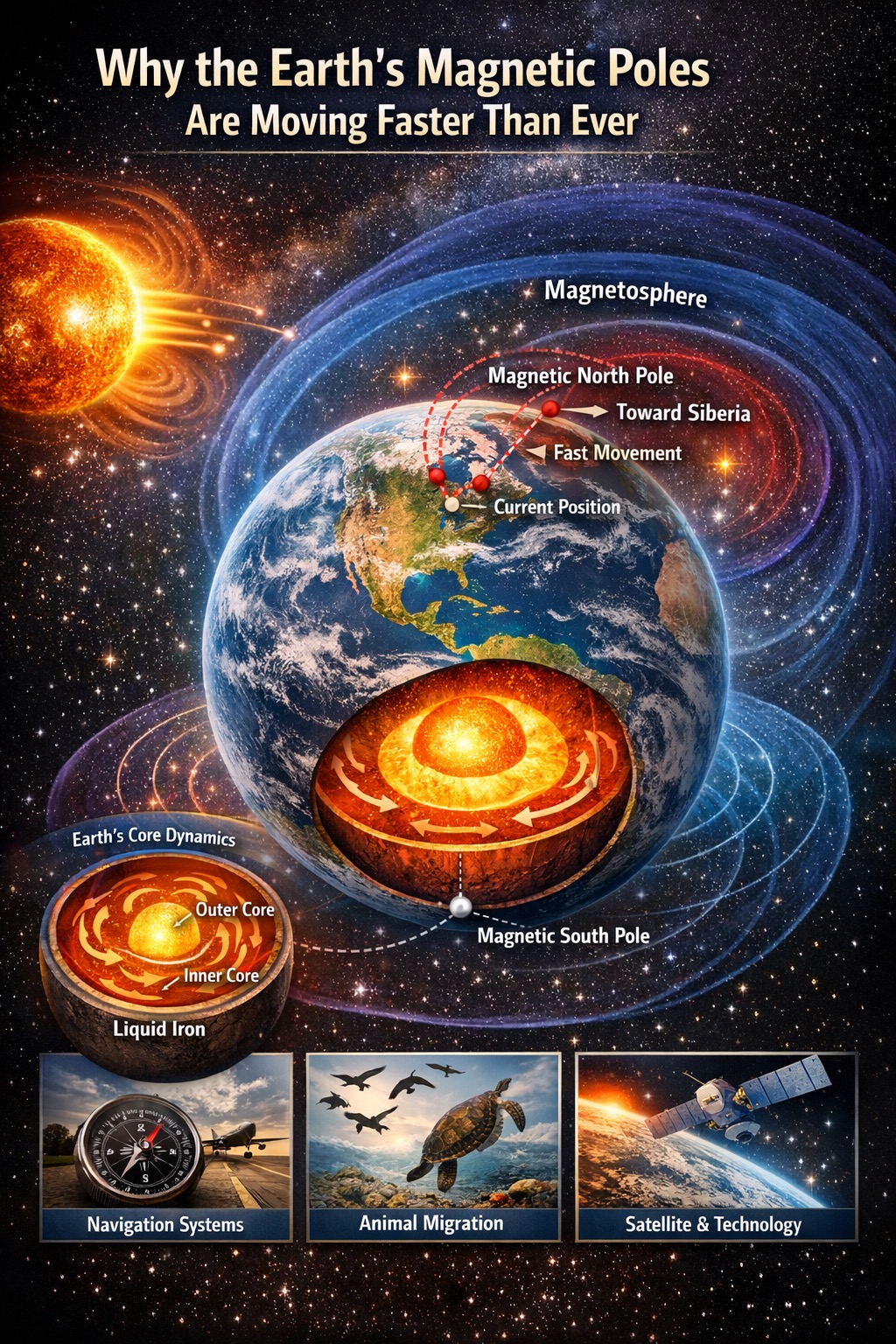
Earth’s magnetic field originates deep beneath the surface in the outer core, a layer composed mainly of molten iron and nickel. The area faces extreme heat which enables its electric conductivity to create complex fluid movements that produce electrical currents. The geodynamo process enables electrical currents to generate magnetic fields which unite into the Earth’s worldwide magnetic field that encircles the entire planet. The Earth’s rotational motion creates an organized pattern which results in the magnetic field taking its typical north-south direction that we can see today.
Historical Movement of the Magnetic Poles
For much of recorded history, the magnetic north pole drifted slowly across the Arctic at a pace of a few kilometers per year. The early explorers and navigators used this slow movement to adjust their compass readings. Scientists observed a significant rise in speed during the late twentieth century. The pole started moving at increased speeds during the 1990s before it accelerated to tens of kilometers per year when it headed toward Siberia from northern Canada during the early 2000s. The system has achieved its highest pole speed since scientists started tracking this data.
Why the Magnetic Poles Are Moving Faster
Changes in Outer Core Flow Patterns
The outer core of Earth undergoes changes which result in its magnetic poles shifting at rapid rates. Scientists have identified large regions of concentrated magnetic energy beneath Canada and Siberia. The magnetic field strength beneath Canada has decreased during the last few decades while Siberia has developed into a more powerful magnetic area. The Earth’s core and crust face unbalanced magnetic forces which cause the magnetic north pole to shift rapidly toward the eastern direction.
Core–Mantle Boundary Influences
The movement of the magnetic poles is also affected by interactions between Earth’s core and mantle. Heat escaping from the core does not flow evenly into the mantle above it. The outer core molten metal circulation patterns depend on core-mantle boundary temperature and chemical composition differences. The modified fluid circulation patterns produce different magnetic field production mechanisms which result in permanent changes to the magnetic pole locations.
Weakening of the Global Magnetic Field
Scientists have recorded through measurements that Earth’s magnetic field has become much weaker during the last 200 years. A weaker field is more prone to instability which enables the magnetic poles to drift more freely. The fast pole movement in modern electric motors does not result from field weakening operations but this technique makes the magnetic system more responsive to core dynamic variations which produces the current fast pole movement.
Natural Secular Variation
The Earth’s magnetic poles show continuous movement because of secular variation which represents Earth’s magnetic field changes at a slow and steady rate. The current situation stands out because its fast and wide-ranging changes occur at speeds which scientists typically experience only across long periods of time.
Are We Approaching a Magnetic Pole Reversal?
Understanding Magnetic Reversals
Throughout Earth’s geological history, the magnetic field has reversed many times, with the north and south magnetic poles switching places. These reversals occur irregularly, roughly every few hundred thousand years, and the last one happened about 780,000 years ago. Scientists now question if Earth will face another magnetic field reversal based on their recent findings.
Does Rapid Pole Movement Mean a Reversal Is Imminent?
Scientists warn that the fast magnetic pole movement does not prove the Earth will experience a magnetic field reversal in the near future. Earth’s magnetic field has experienced previous reversals which took place after the field became unstable for thousands of years. The current fast-paced world has the potential to create stability which would reduce its advancement rate instead of restoring every historical period. At present, there is no definitive evidence that a magnetic pole reversal is imminent.
Impacts of Faster Magnetic Pole Movement
Effects on Navigation and Technology
The fast movement of magnetic poles creates multiple operational difficulties. The accuracy of navigation systems which use magnetic north depends on their periodic updates because they include compasses and aviation charts and military guidance systems. The operations of satellites together with space-based technologies become vulnerable to Earth magnetic field variations which occur when solar activity reaches its peak.
Implications for Animal Migration
Earth’s magnetic field serves as a navigation tool which many animal species including birds and sea turtles and whales use for their movements. The natural navigation systems of these species face potential disruption because of fast-changing magnetic conditions but their ability to adapt seems sufficient for slow magnetic field changes.
What the Future May Hold
Scientists continue to monitor Earth’s magnetic field using satellites and ground-based observatories to better understand its behavior. Earth’s magnetic poles are currently moving at an abnormal rate which occurs in Earth’s active natural systems. Scientists actively pursue research to improve their prediction skills for magnetic field changes because they want to understand how these variations impact technology and Earth’s climate and all living organisms.