
El Niño and La Niña. These two weather occurrences have an impact on the world over. They are part of the climate cycle, the El Niño–Southern Oscillation (ENSO) and occur in the Pacific Ocean near the equator. Yet, due to its location, the effects of ENSO occurrences on weather around the globe are immense. They cause variations in the amount of rainfall and the temperature. They can create an area where tropical storms form. In other instances, an occurrence of the ENSO can lead to extreme instances of drought and flooding. And on occasion the occurrences can have an effect on global commerce.
ENSO is one of the largest drivers of year-to-year climate variability on Earth. This natural phenomenon has been studied for decades, and it is a complex process. When El Niño or La Niña occurs, there are large variations in the ocean temperatures and the atmospheric circulation. In many parts of the world, El Niño can bring floods while in other locations it can bring drought. Other regions can experience an increase in powerful hurricanes, failed crops, heat waves and unusual winters. It also can have an impact on the winter weather in many parts of the globe.
Recently, the terms El Niño and La Niña have been gaining recognition, largely due to the recent occurrence of global warming and the extreme weather conditions resulting from Earth’s increasing temperatures. Learning about these two phenomena will help governments, farmers, businesses, and tourists to deal with the changes in the climate occurring worldwide.
What Is El Niño?
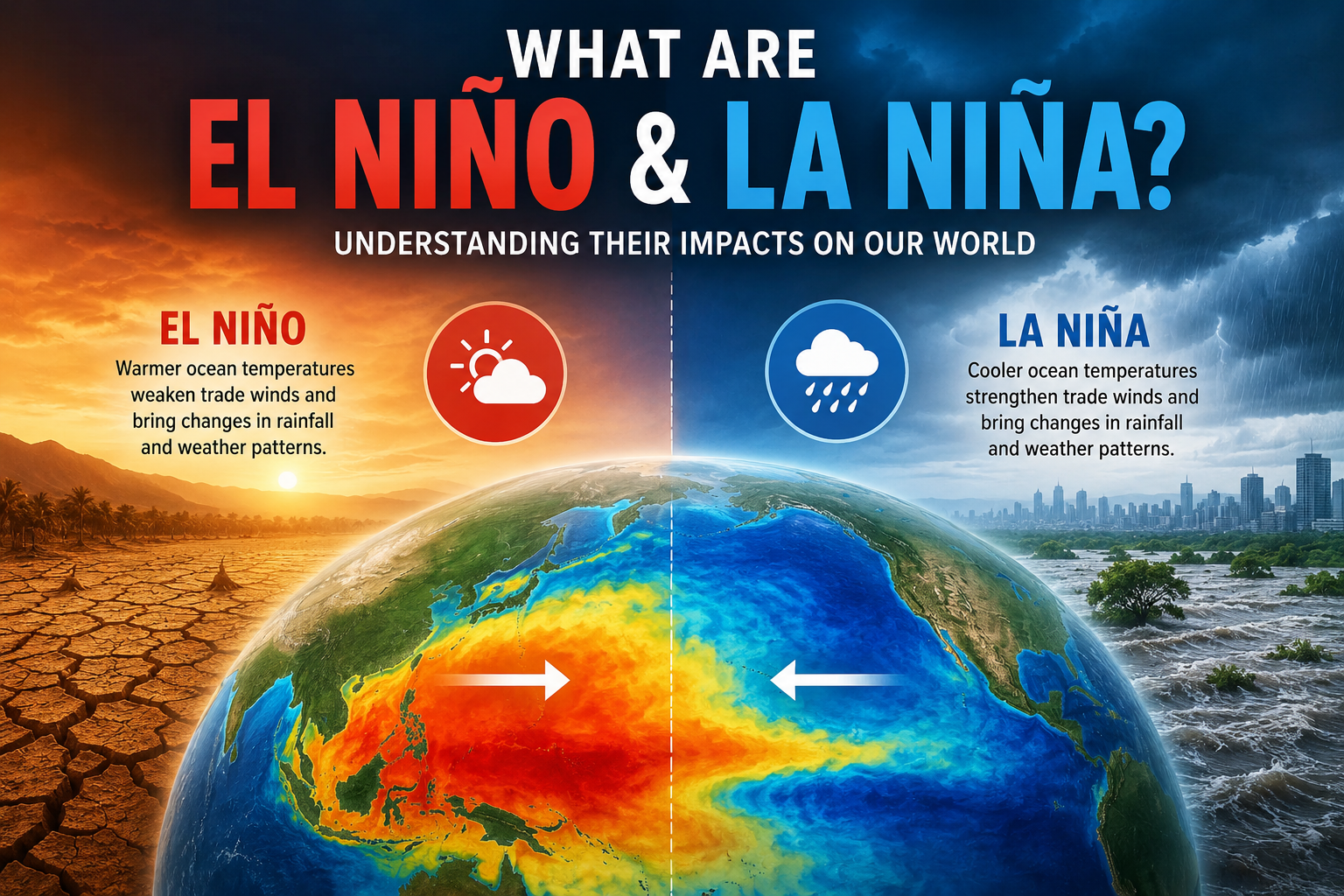
El Niño is a natural phenomenon where the sea surface temperature over the central and eastern tropical Pacific remains above average for at least 9 months and typically for 2 years. El Niño is the warm phase of the ENSO cycle.
Normally the trade winds are blowing from the east to the west over the Pacific Ocean. These winds are driving the warm surface water to Asia and Australia, while along the western coast of South America nutrient-rich water from the deep cold ocean layer is upwelling. During an El Niño event, the trade winds are weakening or even reversing. As a result the warm water from the western Pacific moves to the eastern Pacific, leading to a decrease of the typical upwelling of nutrient-rich water from the cold ocean layer.
As the surface waters warm, there are also changes in atmospheric pressure that go on to affect weather patterns around the globe. El Niño events occur on average every two to seven years, with varying strength from a relatively weak event through to strong events.
The term El Niño was first coined by Peruvian fishermen who have been aware of the periodic rise in surface temperature of the Pacific Ocean about the time of the Christmas season for centuries. They referred to this event as the El Niño de Navidad, or simply El Niño, which translates to The Christ Child.
What Is La Niña?
La Niña is the other phase of the ENSO cycle, it is the “cool” phase and is the reverse of El Niño. The sea surface temperature over the central and eastern Pacific are below average during a La Niña event.
In the La Niña condition, the trade winds are stronger than normal. These winds drive the warmer surface waters across to Asia and Australia. At the same time, cold water from the deeper waters near South America surfaces in stronger upwelling. The Pacific Ocean and its forces of water movement return to their normal, strong condition.
A La Niña event typically can last from several months up to two years. Often La Niña follows after an El Niño event but there is no rule and big differences from year to year can occur. The areas that get too wet during an El Niño will get too dry during the following La Niña event and the other way round for the areas suffering from a drought during El Niño and excessive rain during the following La Niña event. La Niña has effects on weather all over the globe but the opposite ones to El Niño.
How El Niño and La Niña Affect Global Weather
I describe the two climate-related phenomena El Niño and La Niña and their global influence. I also discuss how strong or weak single events of El Niño and La Niña as well as single climate states interact with the geography of single regions and therefore induce strongly variable effects.
El Niño brings heavy rain and flooding in countries along the Pacific coast such as Peru and Ecuador, while droughts. In India a poor monsoon will cause problems with the agricultural harvest and provide the country Australia, Indonesia and the rest of Southeast Asia suffer from dry conditions with an increase in extreme and prolonged with a lack of water supplies. In the US the southern states generally have a wetter, cooler winter while the northern states experience a warmer winter.
During La Niña years, Australia and countries of Southeast Asia typically receive above average amounts of rainfall and can even experience floods. The western states of the Pacific side of the U.S. typically see below average amounts of rainfall while the Pacific Northwest sees increased amounts of rain. Also, the monso-called monsoon in these parts of the world typically is stronger in La Niña years and can also bring excessive rainfall.
As previously stated, El Niño events can affect hurricane activity worldwide. In the Atlantic, upper-level winds are strong enough to disrupt development during El Niño years, leading to weaker hurricanes. Conversely, La Niña events can create a favorable environment leading to an increase in the number and intensity of Atlantic hurricanes.
Impact of El Niño on Agriculture, Fisheries, and Economy
Effects of El Niño on agriculture occur worldwide. Sometimes agriculture suffers from drought, while in other regions the harvest is too big – leading to low market prices and thus lower earnings for farmers. Regions strongly depending on the monsoon, like India, may even harvest poorly in the case of extreme El Niño events.
Another key group affected by El Niño are those involved in fishing industries in South America. The warmer waters, brought by El Niño, prevent nutrient upwelling in the sea, resulting in a dramatic reduction in fish populations. The world’s largest fishery, that for anchovy in Peru, has, on several occasions, reported severe declines in stocks during El Niño events.
The decline in production in all the world’s major agricultural producing countries at the same time puts a huge strain on global transport networks, energy systems and insurance markets. The impact of floods, droughts, storms and wild fires in individual countries can have a ripple effect around the world driving up global food prices.
Various studies have attempted to estimate the costs of very large El Niño events, finding them to be in the hundreds of billions of US dollars worldwide. The 1997/98 El Niño event, often referred to as one of the strongest on record, caused a number of devastating natural disasters and subsequent economic losses around the globe.
Impact of La Niña on Climate and Society
La Niña brings challenges of its own, often being perceived of as the ‘cool’ opposite to El Niño. Large amounts of rain can fill up water supplies and improve agricultural production, however the excess rain can also produce floods and cause landslipes and damage to structures.
While heavy rain may fill up the storage dams and boost agricultural production in regions such as Australia, South Asia will have to grapple with extreme events of floods and landslides and their damage to infrastructure in very high population density.
In the northern parts of North America, La Niña generally leads to a colder winter. But also to an increase of hurricanes in the Atlantic. Stronger hurricanes can be a severe threat to coastlines around the world. They can destroy buildings, cause interruptions to transport and lead to severe financial losses.
Both El Niño and La Niña demonstrate just how connected the climate systems of the world are. A temperature change in the Pacific can bring about a change in weather across continents.
El Niño, La Niña, and Climate Change
Scientists are currently trying to understand the connection between ENSO and climate change. The natural ENSO events El Niño and La Niña have been occurring for thousands of years. However, due to the increasing temperatures of the Earth, the natural events could change in terms of intensity and frequency and also in their impacts on the climate.
Cycles of ENSO naturally occur but the extreme weather brought by El Niño and La Niña events can be amplified by warmer oceans due to climate change. These climate events can bring heat waves, droughts, heavy rainfall and powerful storms.
There are also indications that in the future extremely strong El Niño events may occur more frequently than in the past. However, it is still unclear how climate change could influence the large-scale circulation in the Pacific as well as in the atmosphere.
However, the background temperature of the planet has increased due to climate change. As a result, moderate El Niño events are setting new records for global temperature. It is no coincidence that many of the world’s warmest years have occurred during El Niño events.
Is El Niño or La Niña Going to Hit the World Again?
Yes, El Niño and La Niña are recurring climate phenomena that can be predicted while their Pacific Ocean conditions are still developing. Meteorological organizations such as the National Oceanic and Atmospheric Administration (NOAA), the World Meteorological Organization (WMO) and several climate centers issue forecasts for ENSO events.
Both are typical for the climate on Earth and by no means unusual or unpredictable. However, differences in intensity as well as in timing can be considerable for single occurrences of El Niño or La Niña.
A persistent La Niña as well as a powerful El Niño event in recent years and decades have occurred in the natural course of the Earth’s climate. It is expected that ENSO will continue to impact the world in the future. However, in the ENSO cycle that is part of the natural climate, climate change is expected to have an amplifying effect on the impacts of natural events. Very extreme floods, long lasting droughts, heat waves as well as extremely severe storms are thus expected
Using advanced forecasting systems governments and communities worldwide are better preparing for the impacts of ENSO events. This enables farmers to choose the best crop for the conditions, water managers to fill up reservoirs, emergency services to be ready for possible floods and health services to prepare for heat waves.
How Scientists Predict El Niño and La Niña
Today’s weather and climate forecasting are possible thanks to a number of satellites, as well as a network of buoys on the oceans, climate models, and atmospheric observations. To forecast El Niño and La Niña events, scientists closely monitor a number of indicators, including sea surface temperatures, winds, air pressure, and also the ocean’s currents in the Pacific Ocean.
The Oceanic Niño Index (ONI) is one such indicator used by scientists. This index is used to track the temperature in the central Pacific Ocean. While an above average temperature for an extended period of time may indicate the presence of an El Niño event, a below average temperature for an extended period of time can indicate the presence of a La Niña event.
Now, thanks to numerous observations, high-quality climate models, and effective forecasting methods developed over the last few decades, meteorological centers can predict the coming ENSO events several months ahead of time. Nevertheless, it is practically impossible to make precise forecast of the climate system as complex as our Earth.
P.S.
We live in a global climate system, which can sometimes cause extreme weather on Earth. The two largest climate pattern variability on Earth are El Niño and La Niña. They occur in the Pacific Ocean and cause great changes in weather all over the globe. The two phenomena can bring lots of different changes: More rainfall, less rainfall, higher temperatures and a whole lot of more. They can cause natural disasters such as floods and droughts and affect fishermen and agriculture. Their impact can even be felt on the financial markets.
El Niño events are associated with warmer Pacific Ocean temperatures that can bring in periods of drought, excessive flooding and generally higher global temperatures. La Niña events create cooler Pacific temperatures and are associated with above average rainfall, colder winters in some locations and increased hurricane activity.
Although these cycles are natural, in interaction with climate change their influence on extreme weather may even be increased. Thus the warning, preparedness for weather extremes and climate monitoring are becoming more important.
Understanding El Niño and La Niña helps governments, scientists, businesses and individuals alike to better prepare for the weather changes and for the potential disasters which are climate-related.