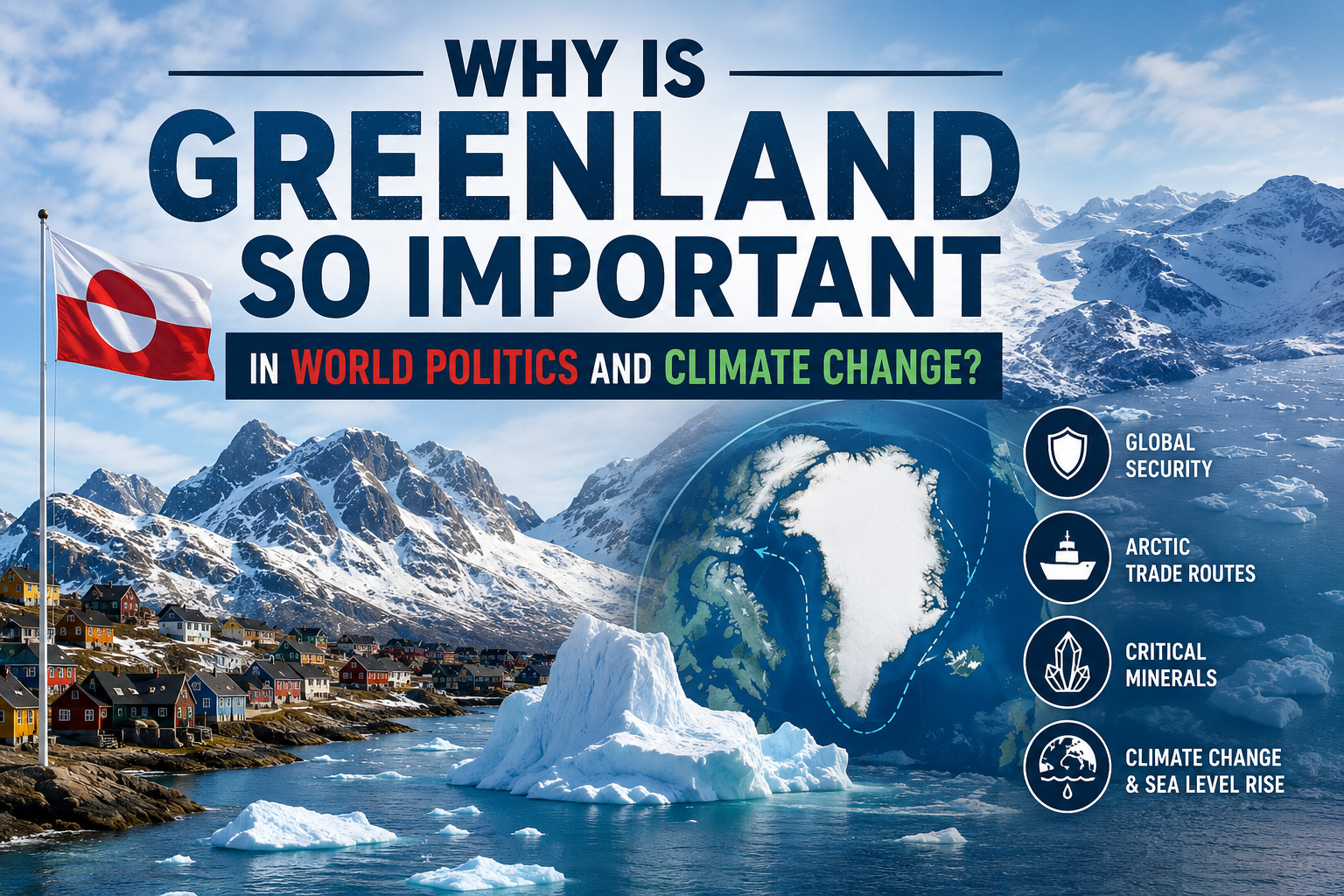

Greenland is becoming an increasingly important place to keep an eye on. It is the world’s largest island, a vast territory in the middle of the Arctic Ocean between Europe and North America with a meager population of 57,000 people. What is more than just proportionate about Greenland are its natural resources, its geographical location and the dramatic change of climate the island is undergoing. That is why Greenland is a central location for the current geopolitical, economic, military and ecological developments that are shaping the 21st century.
Recently, many of the world powers have been competing for Greenland. As shipping routes through the Arctic begin to open up, there has been growing interest in the region. Additionally, many of the world’s critical minerals can be found on the island, and the rapid melting of the Greenland ice sheet has drawn attention to the island. These are just a few of the factors that have brought Greenland to the center of the international community’s attention with regards to global security, energy, climate, and the future of the Arctic.
Greenland’s Strategic Geographic Location
Greenland plays a significant role in current world politics primarily because of its geographical location. Greenland is sandwiched between the world’s largest sea, the Arctic Ocean, and the North Atlantic Ocean. It acts as a link between North America and Europe and thus is strategically positioned along the air ways and sea ways of the United States and Canada and all of Europe.
Greenland is of particular interest to the military because it is strategically located to monitor the Arctic as well as the North Atlantic. During the Cold War Greenland was an important location for early-warning radar systems that could detect missile launches. Today, a new form of Cold War is developing in the Arctic region, and Greenland is once again of great interest to the military.
As the Arctic sea ice continues to melt, Greenland is becoming even more strategically located as new shipping routes open up across the Arctic between Asia, Europe and the Americas, which will save time and reduce the distance of travel between countries. As a result Greenland will become an even more important country to the rest of the world in terms of economics as well as politics.
Greenland’s Role in Global Security and Geopolitics
In recent years Greenland has increasingly become a global issue. As large powers try to gain influence in the Arctic region, also Greenland and the Greenlandic population are becoming more and more important in the global security politics. There are especially a number of major powers trying to make their mark on the island, such as the USA, Russia, China, Canada as well as several European countries.
The US views Greenland as crucial to its efforts to defend the Arctic region. The island is home to the Pituffik Space Base (previously known as Thule Air Base), a vital component in the US space force’s strategy for the region. The base is used for space monitoring, as well as to support missile warning systems and satellite communication for space operations. The base is also used for space surveillance in support of North America.
Russia has been drastically expanding its military presence throughout the Arctic in recent years, modifying existing military installations as well as introducing considerable amount of new hardware and personnel to the region. While it is of considerable concern to the majority of NATO member states, Greenland’s geographical location makes the island the most effective monitoring post and a vital facility for safeguarding transatlantic interests in the face of possible future threats.
A further country which has recently shown an increasing interest in Greenland is China. By investing in projects, by conducting scientific research and by presenting construction projects China tries to win the favor of Greenland and its population. Of course the Western countries, especially USA, are watching with keen interest and with a certain amount of skepticism the foreign investments in Greenland, for fear that China wants to exert strategic influence on Greenland.
Greenland is quickly becoming a more important player globally in the face of increasing competition among countries for influence in the Arctic as its population is only a small fraction of the global population.
Greenland’s Vast Natural Resources
In addition to all the other factors that make Greenland a very important country on this planet, the island is rich in natural resources such as minerals and rare earth elements. Most of these minerals are locked in under the massive ice sheet that covers the island.
There are also huge reserves of rare earth minerals in Greenland. These minerals, which are also known as so called “advanced ceramics” are used in for example electric cars, wind turbines, mobile phones, electronic appliances and for defense purposes. The attention to Greenland’s rare earth reserves has increased because many countries try to create a more diversified supply chain and to reduce their dependence on few countries.
Greenland is home to large quantities of, for example, zinc, copper, iron, nickel, cobalt, graphite and titanium, and many other minerals and raw materials that have a high commercial and strategic value. Critical minerals such as these are needed for the construction of renewable energy solutions as well as for the production of batteries and other industrial purposes.
As the global economy transitions to clean energy technologies, the demand for these so-called critical minerals is expected to increase strongly in the future. Thus, Greenland’s wealth of natural resources could become a major factor in the island’s increasing importance to a global scale, in addition to economic opportunities for the population.
However, exploiting the natural resources in Greenland poses great challenges to the country, including the environmental effects of mining, as well as the social and cultural rights of the indigenous population, and the goals of sustainable development.
Greenland and the Future of Arctic Shipping
New opportunities for Arctic shipping are opening up as a result of climate change and Greenland is becoming an important country in the global trade networks. As the sea ice is covering the Arctic waters all year round, it is preventing the use of the sea for shipping purposes. However, as the sea ice is melting and is covering less area during the warmer months of the year, also the Arctic waters are becoming more accessible for maritime transportation.
New passages through the Arctic region (the Northern Sea Route along the coast of Russian Arctic as well as the so-called trans-Arctic passages) could become much shorter than the currently used Suez-Canal route for transports between Asia and Europe. The savings in distance are up to several thousands of kilometers, depending on the respective start and end points.
From Greenland, a number of emerging Arctic maritime corridors run northwards through Arctic waters. In addition to providing opportunities for new shipping services, search-and-rescue, scientific research as well as development of infrastructure in the region, Greenland can also be used as a service platform for various maritime activities.
Even though the use of the Arctic today is still restricted compared with other global transport routes, experts predict a gradual increase of sea traffic in the future. With respect to this development, Greenland’s ports and coastal areas will likely assume an increasing role as important elements in the future transport systems of the Arctic region.
Greenland’s Ice Sheet and Global Climate Change
Greenland’s huge ice sheet makes it a significant player in the Earth’s climate system. The ice sheet covering 1.7 million square kilometers (about 656,000 square miles) of the island’s surface is the second largest ice body on the planet after Antarctica.
The Greenland Ice Sheet alone contains enough frozen water to raise the sea level by about 7 meters (23 ft) if it were to completely melt and run off into the oceans. Although complete melting would take centuries, Greenland already contributes substantially to the current rate of sea level rise due to melting.
Much of the ice loss from Greenland has been tracked by satellites over the past few decades. Since the early 1990s, the island has lost trillions of tons of ice. As the air above Greenland has gotten warmer, the oceans surrounding the island have also gotten warmer, and the number and intensity of weather events has increased. As a result, the amount of ice lost from the island has been steadily increasing.
The impact of a thawing Greenland extends far beyond the country itself. In addition to the risk of sea level rise to coastal regions around the world, melting ice also threatens cities and other structures on lower ground as well as forests, wetlands, and other ecosystems and resources worldwide. The impact to people could be catastrophic should the sea levels continue to rise and threaten coastal areas around the world where millions of people reside.
Greenland’s Influence on Ocean Circulation
Greenland affects global ocean circulation by numerous rivers of freshwater flowing from the melting ice into the North Atlantic Ocean. These influences could impact global ocean circulation systems that distribute heat worldwide.
Among these is the Atlantic Meridional Overturning Circulation (AMOC), a deep-water circulation system of the North Atlantic Ocean that includes the Gulf Stream and its associated currents. It carries warm water from the equatorial region towards the polar regions and back again on the surface as cooler water. The major ocean currents flow to every continent on the planet, including Europe, North America, Africa and others. Their influence upon local climate and weather patterns as well as on agriculture and the ecosystems in general is enormous.
Much is still unknown about the possible impacts of the growing input of freshwater from Greenland into the North Atlantic Ocean and its effects on the major ocean circulation system. However, any changes in the ocean circulation system could impact weather and climate, influence precipitation and agricultural production, and impact marine ecosystems around the world.
There is considerable uncertainty about the impact that Greenland’s fresh water has on the large scale ocean systems, but most scientists agree that the melting of the Greenland ice sheet is an important component in the global climate system and in the environmental change that the world will face in the future.
Greenland as a Climate Science Laboratory
The area of Greenland is of huge value to scientists as it functions as a natural laboratory for studying the effects of climate change. The study of climate is important to the world and by studying the ice cores that can be found in the Greenland Ice Sheet scientists are able to find out what the climate was like hundreds of thousands of years ago.
The air contained within the bubbles, as well as dust and other particles, and chemical information, within the core provide insight to past temperatures, atmospheric composition, and even past volcanic eruptions. The information gleaned from ice cores allows scientists to better understand past climate change on Earth and how the planet’s climate may change in the future.
Greenland is also a key area for the study of moving glaciers and the dynamics of large ice masses, as well as for the monitoring of Arctic warming and the rise in sea levels. The data collected in Greenland is used in global climate models and in the United Nations climate assessments.
The Arctic is currently warming at a rate of nearly four times faster than the global average in many areas of the world and Greenland in particular is being used as a natural early warning system to better understand these emerging trends and how they may affect other parts of the globe in the future.
Greenland’s Growing Political Autonomy
Greenland is also politically an interesting place to be. Greenland is an autonomous territory within the Kingdom of Denmark. It has extensive powers of self-government, and has had a high degree of autonomy and control of most domestic affairs since the Self-Government Act of 2009. This Act also granted Greenland full control of its natural resources.
A majority of the Greenlandic population would like to extend the autonomy already granted and be able to make more decisions in relation to the country’s economic development. The option of independence is also a current topic in Greenland’s politics.
As Greenland is gaining more attention globally, the Greenlandic government is increasingly involved in negotiations about issues such as mining projects, environmental policies, international investments, Arctic cooperation and the rights of the Indigenous peoples.
Greenland’s decisions on how to manage itself have implications for Greenlanders as well as for other international actors who are interested in the Arctic and in its development and security.
Indigenous Communities and Sustainable Development
A consideration of the importance of Greenland has to start with the indigenous Inuit population living there for thousands of years. They have adapted to the Arctic environment and have been living off the land in a way which respects the natural environment.
Climate change has many impacts on Inuit today including the ways in which they go about their traditional hunting practices, by changing the usual routes that they travel, and the effects on fish and seal populations and also on the structures that the Inuit have in order to house themselves and conduct their daily lives. However, at the same time, there are many new opportunities for economy for the Inuit in Greenland such as tourism, mining, fishing industry, and also in the area of renewable energy.
The future of Greenland’s development will depend on how to balance economic growth and environmental protection while trying to preserve culture and human well-being. Most governments now are adopting more sustainable approaches to development, and the Inuit are an important part of these policies that attempt to satisfy global needs while respecting local views and interests.
The lessons of Greenland’s indigenous Inuit communities provide great insights into issues of human resilience and adaptation as well as the broader issues of climate change.
Economic Importance of Greenland’s Fisheries
Greenland’s economy is to a large extent based on its fisheries. Even though the fish and shellfish from Greenland’s waters are sold on the world market as seafood, most of the value is earned by Greenland. In fact the greater part of Greenland’s exports are made up of seafood consisting of for example shrimp, halibut, cod and other fish species.
The health of Arctic marine ecosystems has, in addition to its global significance, direct implications for Greenland’s economy and the country’s capacity to feed its citizens. Climate change affects ocean temperature and sea ice cover as well as the distribution of species. These factors already influence management of fisheries and the economy’s planning.
As global consumption of seafood is projected to continue to increase Greenland’s marine resources will remain of significant economic importance and lead to an increased pressure for sustainable utilization of its marine resources.
The Future of Greenland in a Changing World
In the coming decades, Greenland’s significance will most likely increase. Due to a rise in geopolitical rivalry, an increased demand for so-called critical raw materials, new shipping routes through the Arctic as well as changes in the climate, the island in the north will attract more and more attention from all over the world.
Decisions on development, environmental protection, increased autonomy or other forms of self-governance and partnerships with international players, will have far-reaching implications for Greenland and for the world’s views on how the Arctic should be governed and how sustainable development can be implemented.
Greenland is a highly relevant region due to its increasing interplay of climate change, security, natural resources and indigenous rights.
P.S.
Greenland is important to world politics and climate change because it is at the core of a number of challenges and opportunities facing the world. The country’s strategic location in the Arctic at the centre of current global security and geopolitical developments, the large quantity of critical minerals in its deposits and their increased importance for the production of clean energy as well as for economic growth, and finally the massive ice sheet from which great chunks are calving off and which influences the sea level and the climate on a global scale, all make Greenland an important country in terms of research as well as in climate change policy and other areas.
As the Arctic is rapidly transforming, Greenland’s influence on the international relations, on the environmental, resource security and climate dimension will continue to increase. Therefore, an understanding of Greenland’s role is crucial for understanding the future of global politics, economic development and the fight against climate change in the 21st century.