
The deepest of the world’s five oceans is the Pacific, with an average depth of about 4,000m/13,124ft. The world’s largest ocean, it encompasses a massive area of 162Mkm²/63Mmi². This great Ocean stretches from the shores of Asia and Australia in the west, to those of North and South America in the east. It encompasses an enormous expanse of Earth’s surface and a fascinating array of the world’s deepest and most majestic landscapes under the sea.
Because it is a very large and deep ocean basin, many parts of the Pacific are very deep indeed. Its deep trenches, of which the greatest by far is the Mariana Trench in the western Pacific, are areas of great tectonic activity.
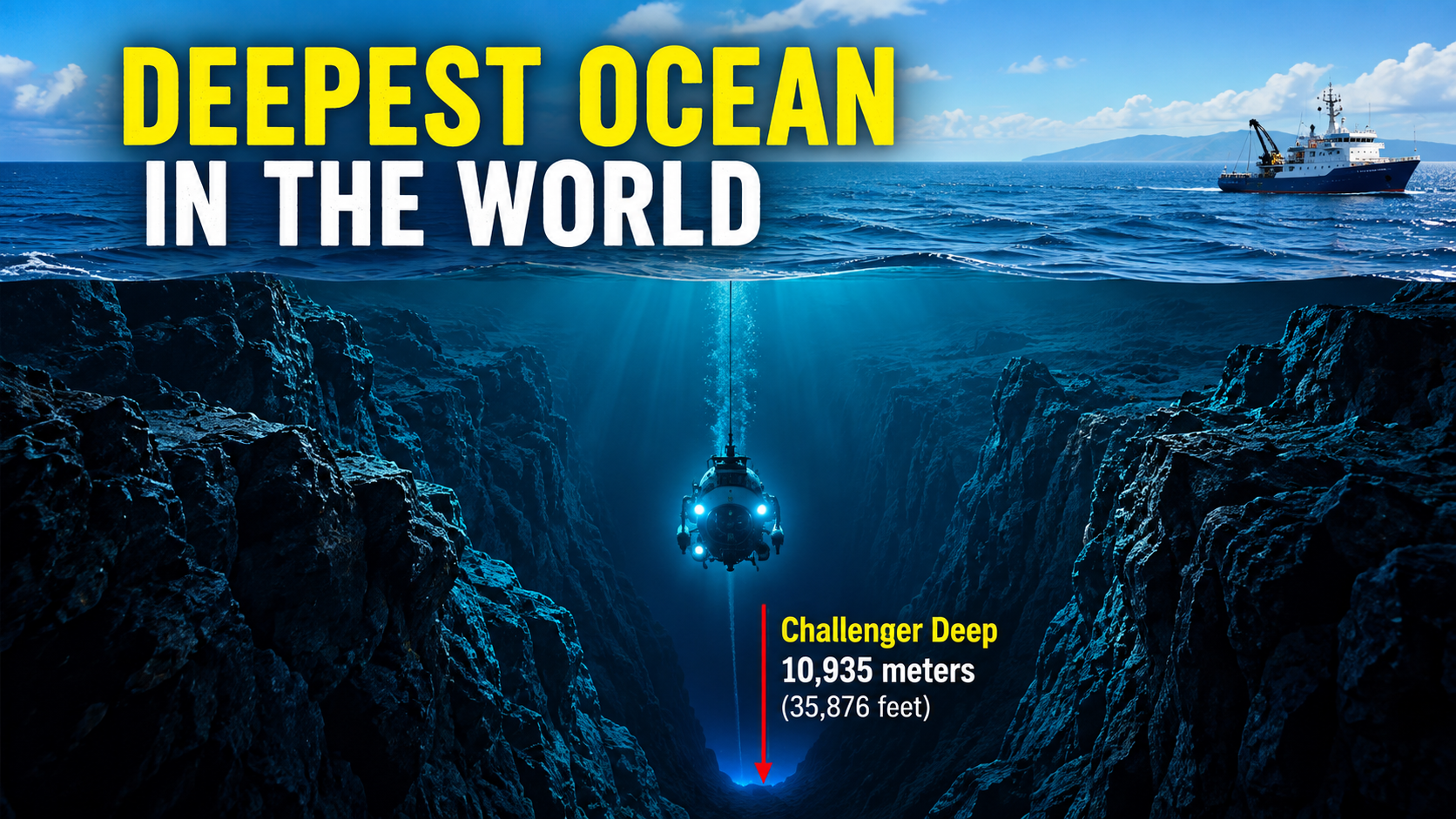
It is called the Challenger Deep and is 10,935 meters below mean sea level. That is about 6.8 miles below sea level. If you laid Mount Everest down on its side into the Challenger Deep, its peak would still be over a mile below the surface.
The great depth of the Pacific Ocean is related to the tectonic plate activity that characterizes the great majority of the basin. At the edges of the ocean, many tectonic plates are moving toward each other and at places where they touch, one of them is pushed under the other in a process known as subduction. The deep-sea trenches, the island arc of volcanoes, the high undersea mountains, and the areas of intense seismic activity are all products of millions of years of such plate movement.
Watch: Journey to the Deepest Ocean in the World
It is often easier to see the enormous size of the Pacific Ocean and the incredible depth of the Mariana Trench when they are printed on a map. In this video we explore the world’s deepest ocean and see where the Mariana Trench is located within the Pacific Ocean. We also take a look at the lowest point in the trench, called Challenger Deep.
The Mariana Trench: Home to the Deepest Point on Earth
The deepest point in the world’s oceans is located in the western Pacific Ocean, near the Mariana Islands and Guam. The enormous, crescent-shaped depression in the floor of the sea extends over 1,500 miles (2,550 km) and has an average width of about 43 miles (69 km).
The Mariana Trench was created at a subduction zone where two tectonic plates are interacting. The Pacific Plate is being forced under the Philippine Sea Plate and as it bends down into the Earth’s interior it creates this incredibly deep trench.
The depression does not have uniform depth but rather has a series of very deep depressions, the lowest and best known of which is the Challenger Deep. This is the deepest point on Earth and, consequently, the Mariana Trench is the deepest oceanic trench and one of the most extreme environments on the planet.
Challenger Deep: The Deepest Known Point in the Ocean
The Challenger Deep is a depression at the southern end of the Mariana Trench. The deepest part of the world’s oceans has been measured to a depth of 10,935 meters (35,876 feet) below mean sea level.
Mount Everest, the world’s highest mountain at 8,849m/29,032ft above sea level, would still be over 2km/1.3m below the surface of the Challenger Deep if it were placed at the bottom of the trench.
Why are there different figures for Challenger Deep’s lowest point? The depth of a point on the Earth’s surface near 11 km below sea level is very difficult to measure. Sligh changes in water temperature, salinity, and pressure as well as tides and the instrument being used can give different results. This results in slight variations between different scientific studies of the lowest point on the Earth.
What Is It Like at the Bottom of the Pacific Ocean?
The environment at Challenger Deep is extreme. Challenger Deep receives no sunlight, it is cold (only a few degrees above freezing point) and very, very deep. We are talking here of nearly seven miles of sea water above the Challenger Deep.
In the deepest part of the trench, near the bottom, the water pressure can reach 16,000 psi (pounds per square inch). This is much higher than atmospheric pressure at sea level, about 14.7 psi. Special equipment is required to withstand such incredible pressure, much greater than what most conventional underwater vehicles can withstand.
The deepest portion of the Pacific Ocean is home to a vast array of life including microorganisms and special deep-sea fish. This bizarre array of animals and microbes survive in the deep Pacific by adapting to the fact that it is dark, cold,has little food and is under immense pressure. The unique life forms that reside in the deep Pacific make it an interesting location for the study of the Earth’s life limits.
Exploring the Deepest Ocean in the World
For most of human history the deepest parts of the Pacific were inaccessible, but on January 23, 1960, Swiss oceanographer Jacques Piccard and U.S. Navy Lieutenant Don Walsh went down into the Challenger Deep in the bathyscaphe Trieste. They were the first two human beings to reach the lowest point on Earth.
Over 50 years later, filmmaker and explorer James Cameron reached the bottom of the Challenger Deep in his Deepsea Challenger on January 23, 2012. Cameron’s incredible journey showed us that the deepest parts of our ocean are accessible with the right amount of engineering.
Currently, scientists use crewed submersibles, remotely operated vehicles (ROVs), sonar, and a variety of sensors including cameras and microphones to explore the Mariana Trench. With these tools, scientists can map the ocean floor, collect samples, and observe life in environments that were previously unknown to humans.
Why Exploring the Deep Pacific Matters
Journeying down to the lowest point of the Pacific is more than just a measure of depth to scientists; it also serves as environments in which to study plate tectonics, seismology, marine ecosystems, ocean chemistry, and extreme life forms.
The deep seafloor can also reveal much about features such as oceanic and continental trenches, ocean ridges, volcanoes and mountains. These are largely unknown features of the Earth because they are hidden beneath thousands of meters of ocean for much of their length.
The Pacific Ocean is so much more than the low point on Earth. From its vast surface down to the dark depths of the Challenger Deep, the Pacific is home to some of the planet’s most dramatic and inaccessible landscapes. Though we can now reach the lowest point on Earth, much of the deep Pacific remains a difficult and largely unexplored environment, holding many secrets for scientists to uncover.