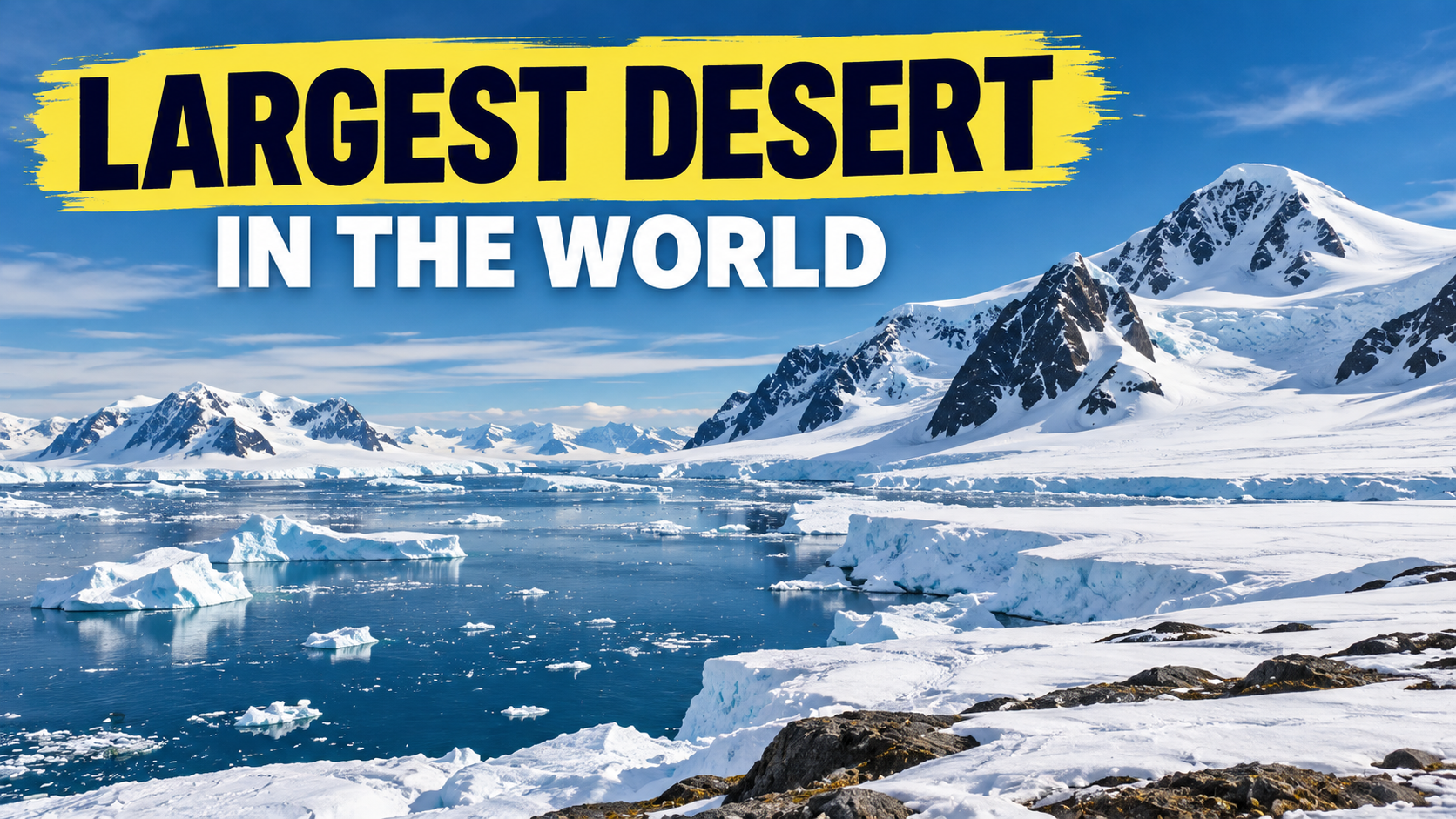

The Antarctic Desert is the largest desert on Earth. Measuring 14.2 million km2 (5.5 million sq mi), Antarctica’s vast desert covers the entire continent. Even though Antarctica is covered in ice and is generally very cold, it is considered a desert because it is so dry and receives so little precipitation in relation to its size.
Although the Sahara is often referred to as the largest desert in the world it is actually the largest hot desert, whereas Antarctica is the largest desert in the world of any type.
Why Is Antarctica the Largest Desert in the World?
Antarctica is a polar desert. On average, Antarctica receives only about 150 mm (6 in) of water in the form of precipitation each year. Some higher interior regions of the continent, however, receive as little as 50 mm (2 in) per year.
Precipitation falls on the continent as snow or ice crystals. The cold dry air over the Antarctic Plateau contains very little moisture.
Despite being one of the driest places on Earth Antarctica is almost entirely covered in ice. Its interior is so cold that much of the snow that falls there does not melt, and instead it builds up and compacts over time.
A “polar desert” which has enormous amounts of frozen water in it – it seems a contradiction!
How Big Is the Antarctic Desert?
Antarctica is a big place. It covers nearly 14 million square kilometers (around 5.38 million square miles). The British Antarctic Survey quotes the total area of the continent including islands and ice shelves as 13,942,065 km2 and the Antarctic Desert covers around 14.2 million km2.
Much of the continent is covered by the Antarctic Ice Sheet, the single largest mass of ice in the world. The National Snow and Ice Data Center estimates that the ice sheet contains approximately 30 million km3 of ice (7.2 million mi3).
The coldest continent on Earth, Antarctica has temperatures ranging from relatively mild in the coastal regions to very cold in the high interior. The lowest recorded temperature on Earth was -89.2°C (-128.6°F) at Vostok Station on July 21, 1983.
Where Is the Antarctic Desert Located?
The Antarctic Desert is found on the continent of Antarctica, surrounding the South Pole. The whole of Antarctica is found almost entirely within the Antarctic Circle and is encircled by the Southern Ocean.
Antarctica is generally considered to be made up of East Antarctica and West Antarctica, with the massive Transantarctic Mountains running between them. The Antarctic Peninsula extends northwards from the Antarctic mainland to South America.
In contrast to the Arctic, Antarctica is a large continent which is mostly covered by ice and is surrounded by ocean. The Arctic is centered on an ocean which is bounded by the northern parts of North America, Europe and Asia.
Largest Desert in the World Video
The vast expanse of the Antarctic Desert is mostly seen as it is – huge and covered in ice and snow. Find out more about the biggest desert in the world in the video below, including its location, size and climate, and find out why Antarctica is considered a desert.
Antarctica vs. the Sahara Desert
In comparison, while the Antarctic Desert is a cold polar desert with ice and snow, the Sahara is the largest hot desert in the world and looks completely different to Antarctica.
The Antarctic Desert covers 14.2 million km2 (5.5 million miles2) and is a cold polar desert that is almost entirely made up of ice and snow. The Sahara Desert, on the other hand, is the world’s largest hot desert, measuring 9.4 million km2 (3.6 million miles2) across North Africa from the Atlantic Ocean in the west to the Red Sea in the east.
The Sahara is by far the largest hot desert in the world and extends across North Africa from the Atlantic Ocean in the west to the Red Sea in the east. While vast expanses of sand dunes get most of the attention, the Sahara is dominated by rocky plateaus, gravel flats, high mountains, deep valleys and salt pans.
While looking very different, both Antarctica and the Sahara are deserts: regions with very low precipitation.
Climate of the World’s Largest Desert
Antarctica is one of the harshest climate regions on Earth. It is the coldest, the driest and windiest continent. The average elevation of Antarctica is high and the low temperatures are caused by this elevation.
Conditions vary considerably from the warmer, wetter coastal areas to the colder, drier interior regions.
The extreme dryness in areas such as the McMurdo Dry Valleys is particularly evident. In these regions, mountains create re-entrants where the normal flow of ice into these areas is blocked. Extremely powerful winds create an extremely dry environment and the few areas of solid ground on the continent, largely ice-free valleys, are amongst the most unusual environments found in Antarctica.
Wildlife in the Antarctic Desert
Life on land in Antarctica is tough, but off the coast of the continent and in the Southern Ocean there is an astonishing variety of wildlife.
Some of the most well known species in Antarctica are the penguins. There are two species of penguins that live on the Antarctic Continent, the Emperor penguin and the Adélie penguin. In addition to these two species, there are several other species of penguins that live in Antarctica and the surrounding subantarctic islands. Other species found in the Southern Ocean include seals, whales, seabirds, and fish. In addition, there are enormous populations of Antarctic krill throughout the Southern Ocean.
On land in Antarctica, apart from a few patches that are ice-free, growth is restricted to low growing plants and fungus including several species of moss, several lichens, some algae and liverworts and two flowering plants native to the region.
There is no native resident population in Antarctica, but instead temporary residents, scientists and support staff from around the world, who live at research stations which are operated by their home countries.
Why the Antarctic Desert Is Important
A lot more than a desert-like wilderness in the world, Antarctica and its huge ice sheet is crucial for Earth’s climate and global sea-levels.
Antarctica contains most of the Earth’s mass of frozen fresh water in the huge ice sheet covering the continent. Change to the glaciers and ice sheets in Antarctica will contribute to global sea-level rise.
Antarctica is one of the globe’s premier climate change research locations, thanks to its massive ice sheet that can contain millions of tons of frozen fresh water. Climate change scientists can learn much about past climates by extracting long layers of ice and the tiny atmosphere bubbles within the ice in cores drilled into the Antarctic Ice Sheet. For example, a number of studies have used ice cores to determine past temperatures, atmospheric gases, and environmental conditions on Earth.
The Largest Hot Desert in the World
Even though Antarctica is the largest desert in the world, the largest hot desert is the Sahara Desert.
The Sahara covers about 9.4 million km² of territory in 24 countries of North Africa. Its size is about equivalent to that of the United States.
The Sahara has extremely dry conditions and lots of sunlight. The Sahara is not all sand – although it does have some big sand seas and big dunes of sand. The entire desert covers a huge area of the Earth’s surface.
A Frozen Desert at the Bottom of the World
In terms of physical size, the Antarctic Desert is the world’s largest, covering 14.2 million km² (5.5 million miles²) or so of massive ice sheets. Most people would imagine that kind of space to look like normal deserts – sandy dunes and all that. Yet it is so dry that it meets the standard definition of a desert.
An important note of distinction to make: while the Antarctic Desert is the world’s largest desert, the Sahara Desert is the world’s largest hot desert. There are many different environments that can be extremely dry, and thus considered deserts, in contrast to what people typically think of when they hear the word “desert”.