
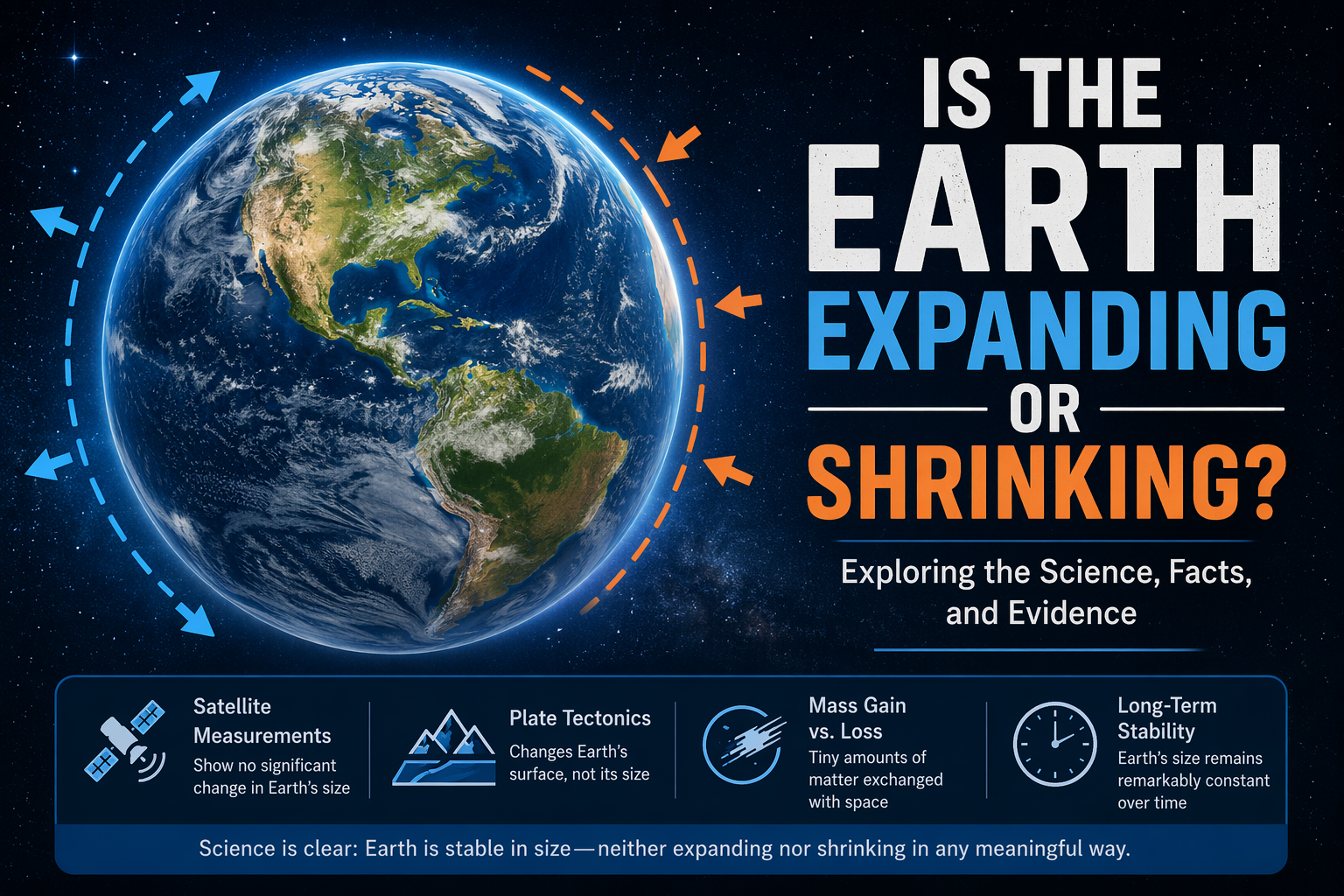

For centuries, man has debated whether the Earth is expanding or shrinking. Early geological arguments have been challenged and recently the extensive data from space acquired by satellites have given conclusive evidence that the Earth is not expanding. The size of the Earth has been precisely determined by the science of GPS, satellite laser ranging and precise geodetic measurements. The variations in size are minute and natural and of no consequence to the Earth or man living on it.
Historical Theories: Expansion vs. Contraction
Between the 19th Century and the early 20th Century many scientists proposed various theories in a bid to measure the size of our Earth. The majority were convinced that the Earth was cooling and believed that it was contracting. Because of this contraction the Earth’s mountains would have wrinkled up like skin on a body that is shrinking. On the other extreme there were proponents of the expanding Earth and what they believed to be the evidence of the Earth’s growing size.
From time immemorial, people have asked the question: how do mountains form? From ancient Greek writers onward, the best explanations offered for mountain building involved the Earth growing in size. There had been no evidence of a physical process to drive such an expansion, and no mechanism to explain the specifics of mountain-building events. Modern geology, including plate tectonics, has revealed the processes that move the continents, making the theory of an expanding Earth irrelevant.
Modern Scientific Evidence: What Measurements Reveal
Many people know that the circumference of the middle of the Earth is about 24 feet less than the circumference at the poles. For many years this was interesting but not earth shattering information. Since the 1970’s we have had a lot of space-based technology, including Earth Resources Laboratory’s own LANDSAT satellite. Scientists around the world use a variety of data, including GPS, satellite laser ranging, and very-long-baseline interferometry (VLBI) to get the most accurate measurements of the Earth’s size.
A number of NASA scientists and other scientists around the world have been measuring the size of the Earth with sophisticated instrumentation, and can report that there are no changes—no shrinking, no growth. The change in the Earth’s radius is on the order of 0.1 millimeters, which is little more than the width of one human hair, and falls within the error of current technologies.
Previous studies have found that variations in the size of the Earth are less than a centimetre per year so size changes are insignificant over human timescales.
There is overwhelming evidence against an Earth that is expanding or contracting.
Why Earth’s Size Appears to Change Locally
Did you know the Earth is 24,902 miles around at the equator, and that it has always been that size? Well, yes that’s true. But despite our spherical companion being fixed in size, it is always going through the process of shrinking or expanding – all around us.
Plate Tectonics and Crust Movement
The Earth has an outer shell which is divided into several tectonic plates that float across the surface of the Earth. The new Earth crust is created at mid-ocean ridges, while the old one is recycled back to the Earth’s mantle at subduction zones. The process of creation and destruction of the Earth crust is perfectly balanced in order for the size of the Earth to remain constant.
Geological Deformation
Mountain building, and valley development result from plate movements towards or away from each other during collision and rifting events. These processes change the Earth’s surface but do not significantly change the radius of the Earth.
Isostatic Adjustment
After glaciers have retreated from recently glaciated areas, land surface appears to rise as newly visible terrain moves upwards following the depopulation of the glaciers. In addition, the uplifted land surface has a greater volume of mass per unit area than previously, as it comprises a compressed land surface that is slowly adjusting to its new circumstances.
Mass Gain vs. Mass Loss: A Subtle Balance
Most people imagine the Earth to be a more or less sealed package, like a balloon filled with air, but it is not. The Earth exchanges mass with space every year.
Lecture slides on space shown to us state that Meteorites and space dust add about 15,000 tonnes to the Earths mass each year, whilst gases escape into space at a rate of 75,000 tonnes each year.
While there is a small net loss of mass, this is only a small proportion of the Earth’s mass and would take billions of years to reduce the Earth’s diameter by just a few centimetres.
Long-Term Geological Perspective
Since the Earth has never been static, there must have existed processes which modified its constitution over billions of years, as it gradually cooled and the slow circulation of material in the Earth’s mantle proceeded. Evidence suggests that the Earth contracted in early stages of its evolution; as a result, its circumference might be several kilometers less than it is today.
The Earth’s crust has shrunk. This shrinkage occurred over billions of years and in fact the Earth has not undergone any appreciable changes of size in the hundreds of millions of years since the dinosaurs roamed the Earth. The radius of the Earth is given in several modern sources as 6 378 km with an uncertainty of about 1 m.
Scientific Consensus: A Stable Planet
There is evidence in science that shows the Earth is not growing. In fact, geologists agree that the size of the Earth is constant with no evidence of any expansion. Additionally, the precision with which we can measure the Earth and its features is high enough that any changes in size would be undetectable. For these reasons we can consider the Earth to be a constant size.
Keeping the Earth the right size for humans to live on is crucial for maintaining a stable Earth climate, a strong gravity field, and a geologically stable planet.
Conclusion: Earth Is Neither Expanding Nor Shrinking
We have already seen that neither “expansion” nor “contraction” of the Earth are supported by current scientific theory. Many scientists in the early days of geology thought the Earth was constantly expanding or contracting. Today’s most precise measurements, however, demonstrate that the size of the Earth is constant. Changes due to geological processes, atmospheric loss or gain of cosmic material, etc. are small and insignificant.
Our planet is a stable dynamic system – always the same size yet constantly changing, with the surface of the Earth in a state of continuous flux. This view of our planet and our environment is one that is supported by our senses as well as by the current understanding of modern Earth science and the evidence derived from observation of our planet.