
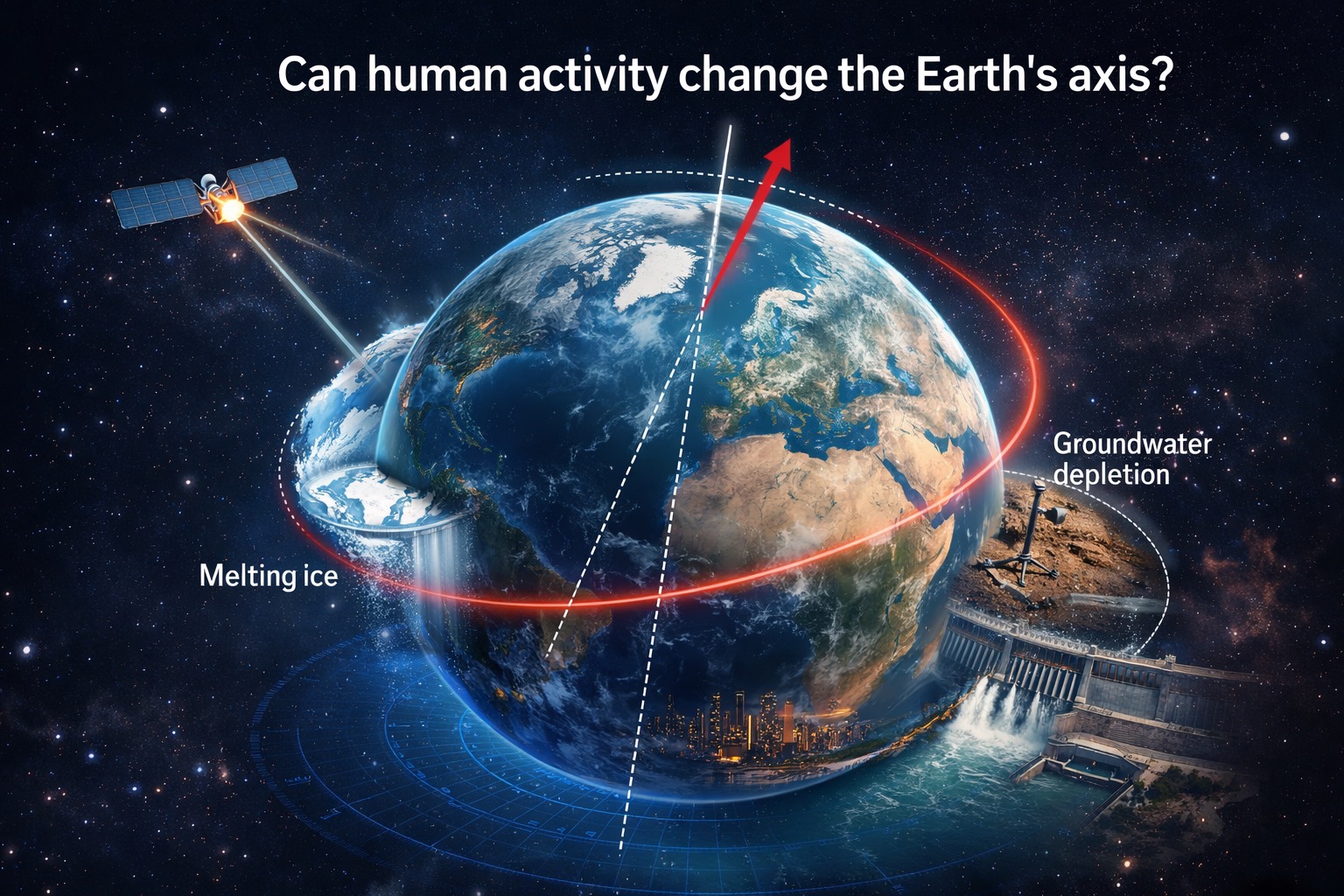

Is the Earth’s Axis Truly Fixed?
The Earth presents itself as a solid body which remains motionless but scientists prove the planet exists in a state of continuous movement because of various internal and external natural forces. The Earth experiences two types of axis orientation changes which occur in addition to its regular solar year and daily planetary spin. Scientists today conduct research which shows human activities produce measurable changes that make scientists question whether humans can control Earth’s rotational axis.
Understanding the Earth’s Axis
What Is the Earth’s Axis?
The Earth’s axis is an imaginary line running through the planet from the North Pole to the South Pole, around which the Earth rotates once every 24 hours. This axis is tilted at about 23.5 degrees, a tilt that is responsible for the changing seasons. Even small changes in the position of this axis can be measured with modern technology, though they are far too small to be noticed in everyday life.
Natural Movements of the Earth’s Axis
Axial Precession
Scientists have identified axial precession as the Earth’s axis follows a 26,000-year circular path during this time period. Earth moves naturally because its gravitational bond exists between the planet and both the Sun and the Moon. The process happens naturally because it has been taking place for millions of years.
Polar Motion
In addition to long-term precession, the Earth experiences polar motion, where the geographic poles drift by a few meters over time. The Earth experiences this phenomenon because it maintains its shape as a sphere but lacks complete rigidity. The planet operates as a slightly flexible body which wobbles through its rotational motion.
The Physics Behind Axis Shifts
The Earth’s axis can shift when the planet’s mass distribution changes. The Earth experiences changes in its balance when substantial amounts of mass either approach or retreat from its rotational axis. This follows the same physical principle as a spinning figure skater extending their arms to slow down. The distribution of massive amounts of mass throughout the planet through any process will affect the planet’s mass distribution.
Can Human Activity Affect the Earth’s Axis?
For most of Earth’s history, only natural forces such as tectonic movements and ice age cycles influenced the planet’s axis. Human activities have grown to such an extent that they create quantifiable changes in the environment. Human activities fail to create major planetary tilts but they do lead to detectable changes in the Earth’s surface.
Groundwater Extraction and Axis Drift
Groundwater extraction stands as the most important human impact which affects the environment. Humans have pumped trillions of tons of water from underground aquifers for agriculture and urban use. The movement of water between rivers and oceans results in changes to Earth’s mass distribution pattern. Research data shows Earth’s axis has shifted by multiple centimeters because of groundwater extraction which took place during the previous few decades.
Melting Ice Sheets and Glaciers
Human activities through climate change have caused Greenland and Antarctic glaciers and polar ice sheets to melt at an increasing rate. The process of ice melting creates a mass transfer which transports substances from land to oceanic water bodies. The weight transfer between Earth’s surface and atmosphere produces detectable changes which result in Earth’s rotational speed adjustment and polar region displacement thus making ice melting the main human-induced factor which controls axis movement.
Large Dams and Reservoirs
Big dams and reservoirs built during large-scale engineering projects result in small modifications which do not affect Earth’s axis rotation. The process of reservoir filling results in the movement of large water amounts which get distributed across extensive surfaces. The process results in a minimal increase of Earth’s moment of inertia which produces small modifications to Earth’s rotational speed and its axis orientation that scientists can detect through millimeter-scale measurements.
Urbanization and Mass Redistribution
Modern cities have their infrastructure and building materials including concrete and steel and steel and infrastructure concentrated in particular areas. The total mass distribution of Earth experiences minimal changes because of individual cities but the expanding number of cities across the world leads to a major global mass reallocation. The minimal impact demonstrates that human activities have started to influence all regions across Earth.
How Scientists Measure Axis Changes
The process of detecting these small alterations needs highly advanced measurement capabilities. Scientists conduct their research through the combination of GPS networks and satellite laser ranging and atomic clocks and very long baseline interferometry (VLBI). The research tools enable scientists to measure both tiny axis position changes of millimeters and brief day length variations of microseconds.
Are These Changes Dangerous?
Human activities have introduced modifications which do not create any dangerous threats that endanger the Earth at present. The activities do not trigger earthquakes and they do not affect weather patterns or disrupt normal operations. Earth’s motion remains under the control of natural forces which include earthquakes and ocean circulation patterns.
Myth vs Reality
Myth: Humans can dramatically tilt the Earth’s axis
Reality: Human influence causes only tiny, gradual shifts
Myth: Axis changes will lead to sudden climate disasters
Reality: Seasonal cycles remain stable
Myth: Earth is becoming unstable
Reality: The planet remains well within natural limits
Why This Matters Scientifically
The fact that human activity can be detected in Earth’s axis movement is scientifically important. The system shows total system connection between Earth’s systems because it demonstrates how human water usage leads to climate change which then impacts Earth’s physical planetary systems. Scientists use this data to improve their climate models which help them predict future environmental changes.
Conclusion: A Subtle but Powerful Influence
Human activity can change the Earth’s axis, but only by incredibly small amounts measured in centimeters and millimeters. Human activities have started producing quantifiable changes which affect the entire planet because Earth’s systems operate without any danger from their natural processes. The Earth continues its eternal movement through space while human activities have caused a minimal disturbance to its natural balance.